The Whole Forest: A Unified Path for New England’s Landscapes
May. 19, 2026
A guest blog from Yale School of the Environment students
Read More


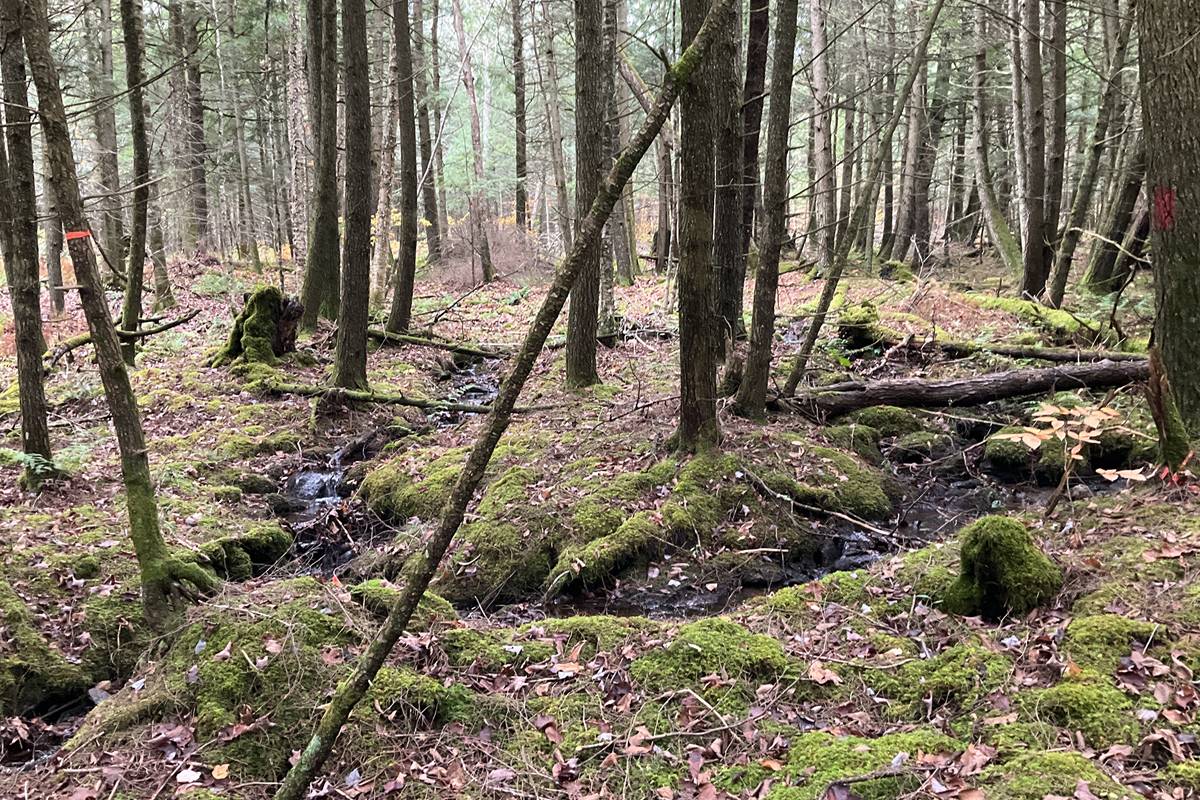
As we make our way through ever-darker days toward the winter solstice, it seemed like the right time to break out a good-news blog post. NEFF has permanently conserved four forests that total 1,015 acres since May 1 when our fiscal year begins, and is working to conserve an additional 543 acres by the end of December. We’ll update this post about the three properties whose deals still aren’t finalized throughout the month.
Update Jan. 6: NEFF has conserved all three of these pending properties, bringing our total conserved acreage to 1,558 acres!
The four forests we’ve already conserved are parts of wildlife corridors and offer spectacular habitat, are home to both winding brooks and a working sugarbush, provide great views, and, in one particular case, are the site of a Northern White Cedar Seepage Forest, an uncommon natural community according to the State of Vermont that’s known to attract Canada warblers, northern parula, yellow-rumped warblers, and, occasionally, northern saw-whet owls. This is clearly a winning group of conserved lands.
Note: NEFF continues to partner with the Vermont-based Cold Hollow to Canada organization, which funds collaborative land conservation in their region. Their mission is to maintain ecosystem integrity, biological diversity, and forest resiliency throughout the Cold Hollow to Canada region in the northern Green Mountains. Two of NEFF’s 2025 projects are therefore collaborative, Vermont-based easements that foreground a key NEFF priority: biodiversity.
464 acres in Wallingford and Tinmouth, Vermont
Conserved by NEFF Dec. 23, 2025
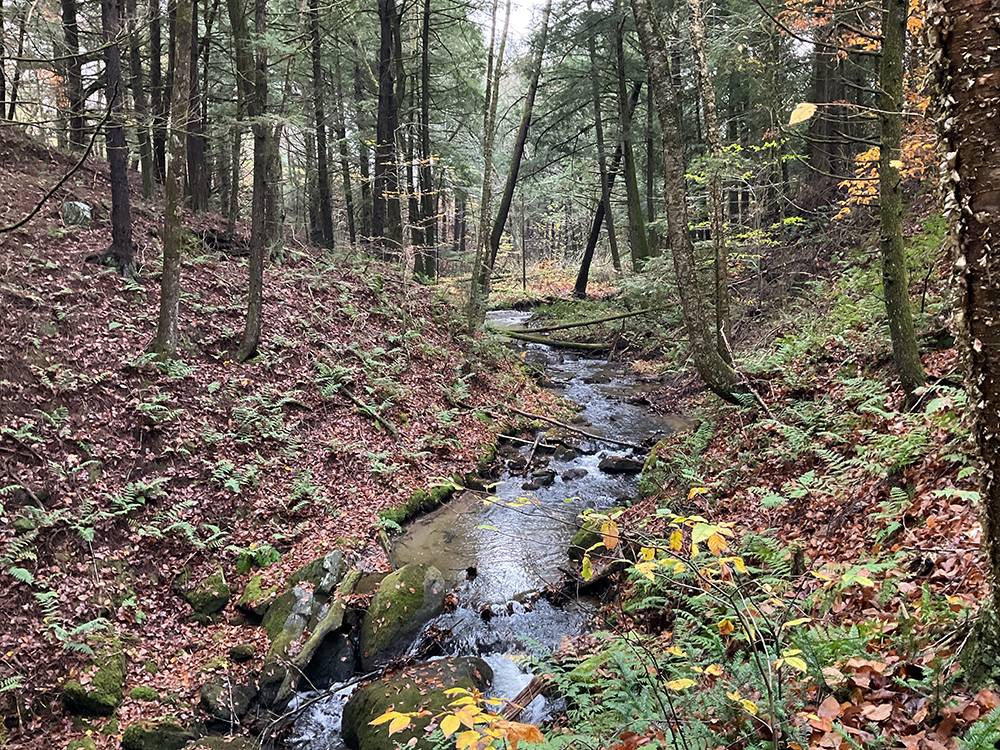
This new NEFF Community Forest is just west of the Green Mountain Forest and several large Vermont Land Trust conservation easements. It has had ongoing management of high-quality timber and has implemented cost share projects with NRCS for timber stand improvements, crop tree release, road stabilization, and installing an access road for harvesting firewood. The eastern slopes of this property drain into a few small streams that then join to form Dugway Brook. Local sugarmakers have tapped maples on this property for generations, and that tradition continues today. There are woods roads throughout the property and access off of West Hill Road.
Co-held with Vermont Housing & Conservation Board
77 acres in Bakersfield, Vermont
Conserved by NEFF Dec. 30, 2025
Mark Woodward donated this easement to honor the wishes of former property owner and his dear friend, Debra Mason, who wanted to protect this land but passed away in March 2024.
The easement is located within an area of relatively unfragmented forestland by the easternmost edge of the Champlain Hills biophysical region, which represents an important transition zone for wildlife moving between this region and the adjacent highlands of the Northern Green Mountains to the east and lowlands of the Champlain Valley to the west. Conserving natural cover and preventing further fragmentation and conversion in this transition zone is a critical strategy to protect Vermont’s biodiversity and ability to be resilient in the face of climate change.
The easement is also located within a key ecological linkage identified by the Staying Connected Initiative and partners referred to as the Northern Green Mountains linkage. These linkages are discrete areas within the broader Northern Appalachian-Acadian ecoregion — the largest broad leafed temperate deciduous forest remaining in the world — delineated for their significance in maintaining landscape-scale connectivity so native species can effectively move through the landscape and maintain their ability to adapt to the impacts of climate change. Protecting forestland with willing landowners like Mark Woodward within the Northern Green Mountain linkage — one of the wildest and least protected in the northeast — is a critical strategy to protect biodiversity and climate resiliency.
Co-held with Ashby Land Trust
2 acres in Ashby, Massachusetts
In 2003, Bill Arnold and his late father Vincent Arnold donated a conservation restriction to NEFF and Ashby Land Trust, protecting 15 acres of their hay fields and Christmas Tree farm on the Massachusetts-New Hampshire border. In 2005, they furthered their commitment to conservation by donating a 32-acre conservation easement and forest management rights to NEFF on their woodlot in New Ipswich, New Hampshire.
In recent years, Bill Arnold offered to expand the restriction on the Massachusetts side by adding a 2-acre undeveloped parcel to its protections, located across the road from the Christmas Tree field. The parcel is characterized by part of an old field and patches of young forest, surrounding a shrub swamp and marsh wetland located partially on the lot. Protecting this parcel contributes to an extensive network of nearby conserved land on both sides of the state line, including other NEFF easements as well as land protected by Ashby Land Trust, The Monadnock Conservancy, and the Towns of Ashby and New Ipswich.
Sweet Conservation Easement
Co-held with Vermont Housing & Conservation Board
696 acres in Montgomery, Vermont
Conserved by NEFF Oct. 17, 2025
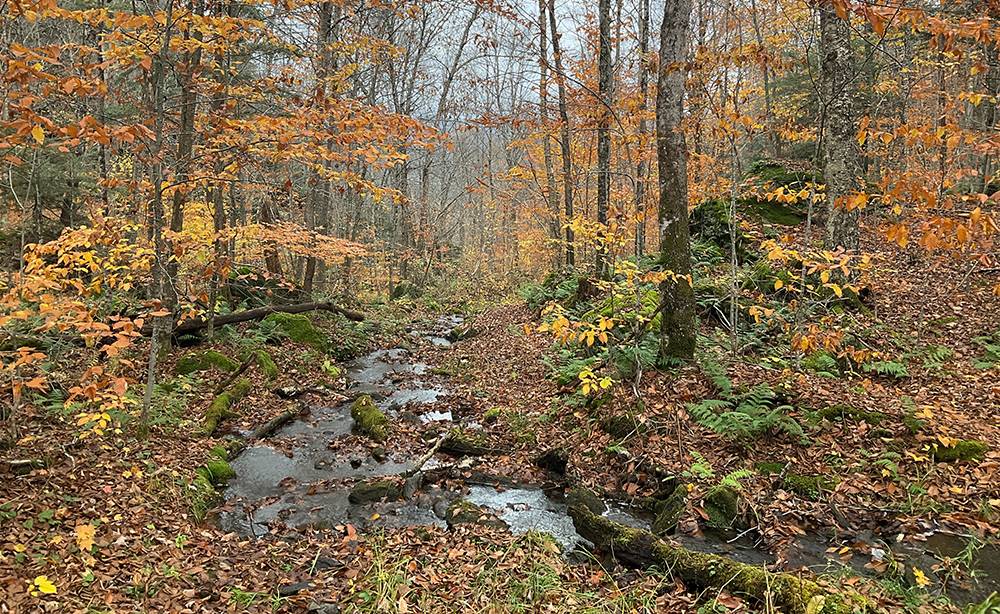
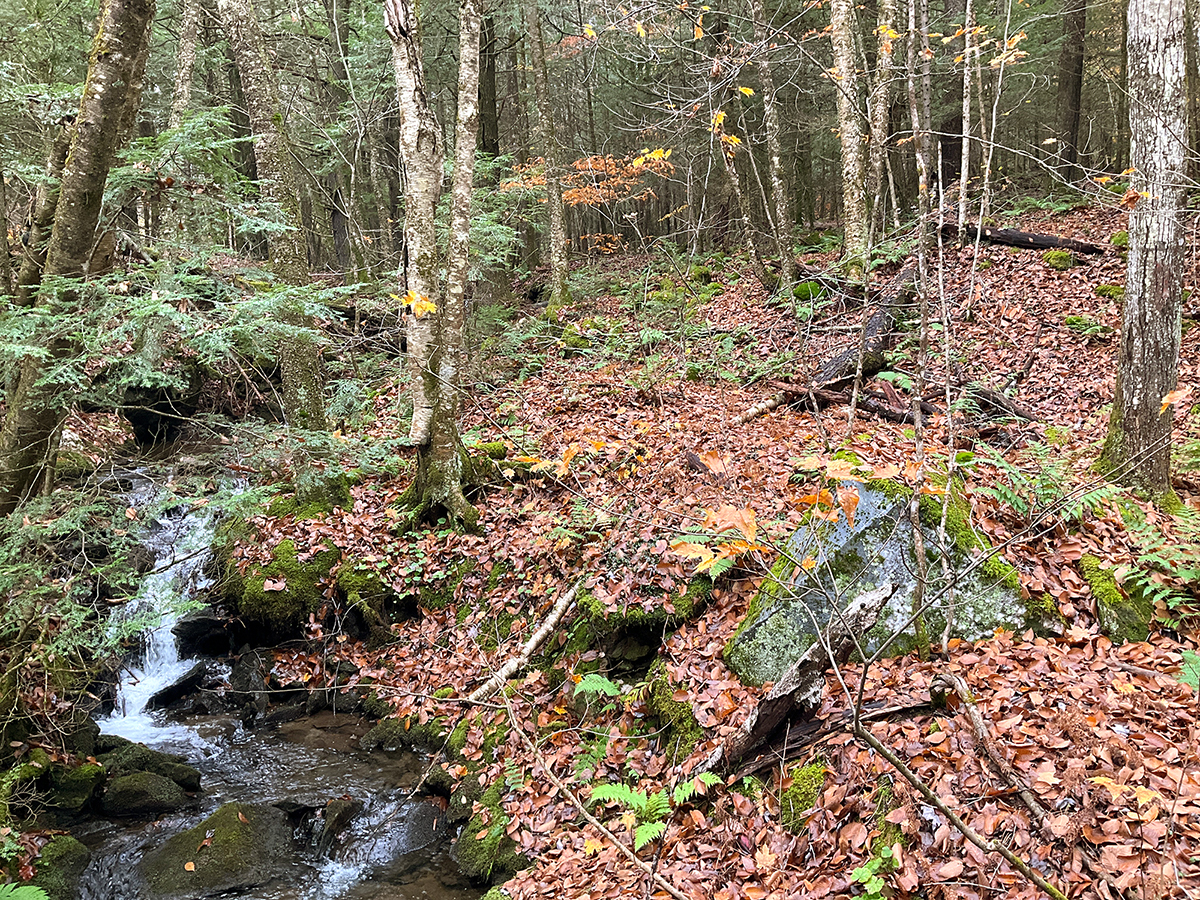
The lushly beautiful Sweet forest is a working sugarbush property on rugged hillsides, swept through with brooks and streams, and also an essential parcel to protect near Montgomery Center, as nearly the entire forest — more than 99 percent — lies within what’s called a Highest Priority Connectivity Block and Interior Forest Block, as identified by Vermont Conservation Design (VCD). VCD is a Vermont Fish and Wildlife Department prioritization tool that identifies and maps ecologically important lands and waters. By conserving this land, NEFF and its partner in holding the easement, Vermont Housing & Conservation Board (VHCB), help keep ecosystems connected and prevent further fragmentation of the Cold Hollow region’s forests.
The Sweet property is managed for maple sap and timber production, along with maintaining and enhancing wildlife habitat, under the guidance of a state-approved Forest Management Plan.
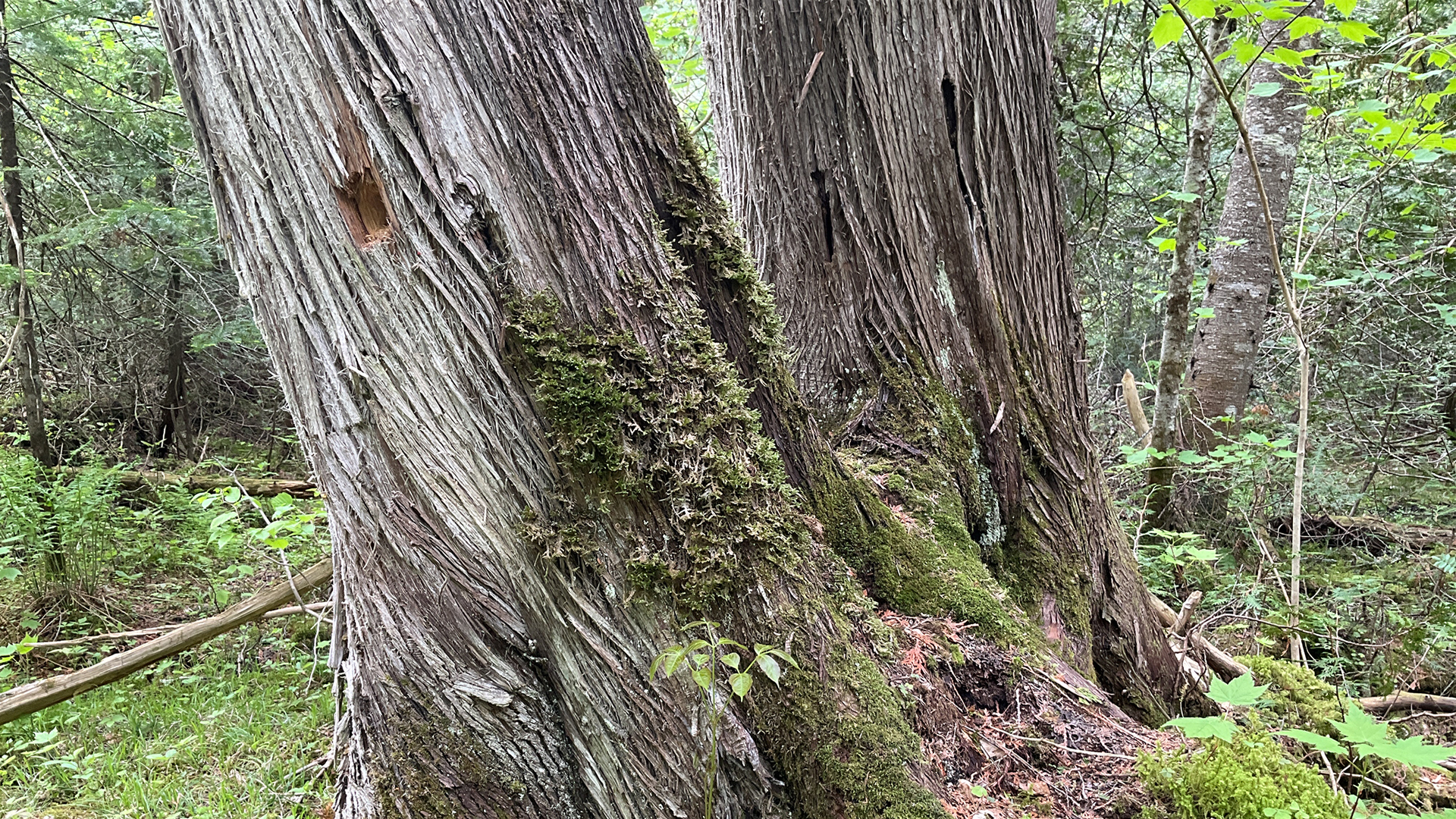
Northern White Cedar Seepage Forest in the Willey Woods addition, photo by Andrew Bentley
Co-held with VHCB
60 acres in Burke, Vermont
Conserved by NEFF Nov. 14, 2025
This addition to the Town of Burke’s 283-acre Willey Woods Community Forest, under a 2022 conservation easement held by NEFF and VHCB, creates a combined 343-acre Community Forest that will be permanently protected by the easement. Hunting, snowmobiling, and general passive recreational use are quite popular here, with many local hunters taking advantage of one of the few unposted lands in West Burke with good wildlife habitat. Expanding on the Willey Woods Community Forest will protect a stepping-stone of habitat and forestland between this block and Victory State Forest to the southeast, and West Mountain Wildlife Management Area to the east.
According to Vermont Conservation Design (VT Fish & Wildlife, 2015), the property is within a VCD Priority Interior Forest Block and Highest Priority Connectivity Block, and also abuts a Highest Priority Block-to-Block Wildlife Road Crossing. Based on Dr. Mark Anderson’s Resilient Sites for Terrestrial Conservation in the Northeast and Mid-Atlantic Region, produced by The Nature Conservancy, the majority of the property is classified as a corridor of natural land between a fragmented landscape containing connected microclimates that increase the persistence and retention of biodiversity even as the biota changes.
The 60-acre addition will ensure protection of Roundy Brook, the headwater streams of which run through Willey Woods, and it will protect areas of Northern White Cedar Seepage Forest, an uncommon natural community. According to Vermont Fish and Wildlife, “Northern White Cedar Seepage Forests occur on gentle slopes and have shallow accumulations of highly decomposed organic soil, which is typically less than 1.5 feet deep. … Even when water is not visible, it can often be heard gurgling and trickling below the shallow roots of the cedar trees…. [They] have closed canopies and typically have sparse shrub, herb, and bryophyte cover. The dense canopy is dominated by northern white cedar.”
104 acres in Littleton, New Hampshire
Conserved by NEFF Oct. 22, 2025
This property was owned by a neighborhood association called Warden Conservation Association (WCA) since 2009 and stewarded as a NEFF conservation easement since 1990, protecting forested open space punctuated only by an electric utility corridor across its northern extent with views of Moore Reservoir on the Connecticut River in the valley below. In 2024, WCA generously offered to donate the land to NEFF, and the donation was completed in Autumn 2025. The forest is named in memory of Irene and Dr. Alexander Warden, who had a local practice and is remembered for making house calls out of his Volkswagen Beetle. The Wardens owned this and surrounding lands until the late 1980s. The lot has not been harvested since the 1980s, and today has a mix of spruce/fir and northern hardwood stands on its hillside terrain.
Thissell Smith Memorial Forest
155 acres in Ossipee, New Hampshire
Conserved by NEFF Nov. 21, 2025
Geraldine Smith donated the original 165-acre Thissell Smith Memorial Forest to NEFF in 1989 and also founded the Geraldine D. Smith Conservation Trust, which conserved 155 acres through two NEFF conservation easements. The first easement conserved 82 adjacent acres in 1992, and the second conserved another 73 acres in 2016; Geraldine had by then passed away, and her nieces — Elizabeth Gillette, Lois Toomey and Janet Kenty — took over management of the Trust. They have now donated the combined 155 easement acres outright to NEFF, nearly doubling the size of the memorial forest.
The new forestland is actively managed and bounded by NH Route 16 to the east, an old railroad to the west, and NEFF’s Thissell Smith Memorial Forest to the north. This protected area includes one mile of continuous forested road frontage, which is an important wildlife transit zone between wetlands east of Route 16 and the Ossipee Mountains to the west. The terrain is generally moderate with a steeper slope along the western boundaries that descend to an old rail line just outside the properties. White pine, oak, hemlock, and other hardwoods are the forest’s primary species.