Stewarding the Future Forest at Sortwell Memorial Forest
May. 22, 2026
A planned timber harvest at Sortwell Memorial Forest will help guide the next…
Read More


March is not May in Maine. It is not the month of woodland spring beauties and heartleaf hepatica, of trout lilies and fiddlehead ferns, as migrating warblers return to sing sweetly from the mid-story or the tree tops. It is not when so many tree buds unfold into young leaves that color-wash the winter-weary hills and valleys in innumerable shades of green that the mornings thrum with new life. No. March is not poetry. It’s damp. It’s dreary. The days are longer, yes, but the month feels longer still. March is mud.
And yet, even as frost-heaves crater the back roads and ice-rimmed ponds and patchy snow hang on in the shadows, late winter yields to very early spring. It’s subtle magic: the red osier dogwood stems turn scarlet against the brown and grey landscape and the bark on the young aspens flushes with a hint of green, and in the woods a bird and a frog quietly start to sing to call in a mate.
Woodcock, also known as Timberdoodles, are dark-eyed birds with long knitting-needle-like beaks and feathers that look like a pile of dead leaves — thus making them almost impossible to detect on the forest floor. They typically arrive in Maine from their wintering grounds in the southern Atlantic and Gulf Coast region in the first half of March. They often arrive when there is snow on the ground and ice still on the ponds. To feed, they need some unfrozen ground in damper areas to probe in the mud for invertebrates. On the coldest of late winters, and this may be one, I have seen them in yards probing the unfrozen ground on the southern side of the house for earthworms.
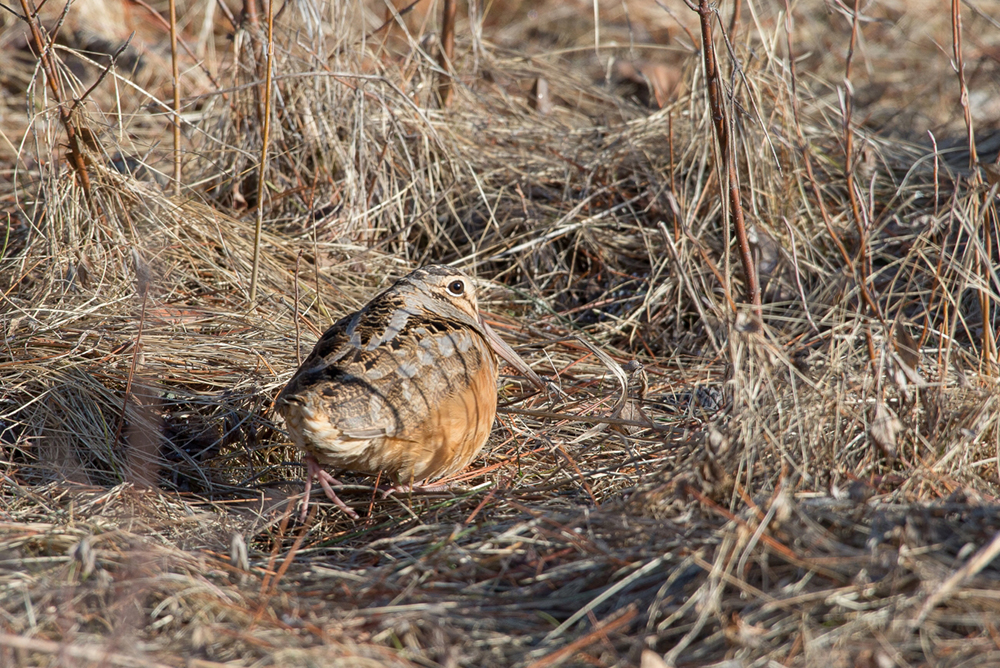
Woodcock have excellent sight and hearing. This woodcock is likely on the singing grounds, or dance floor, in late winter, alert to either a potential threat or competitor or perhaps listening for earthworm movement below ground. American Woodcock, Ramos, Keith/USFWS, Public Domain, https://www.fws.gov/media/american-woodcock-2
That’s uncharacteristic. Not only are they the shyest of birds, they are also crepuscular or most active after sunset and in the dim half-light before dawn. But by early March they are in full courtship mode, especially on moonlit nights. Males take to the stage in an open field or a gap in the woods and strut in a jerky circle dance while calling out “peent, peent, peent” in the hopes of attracting a female who, presumably, is watching from a safe distance. The dancers are almost impossible to see in the dim light, but they have excellent eyesight and are adept at blending into the surroundings if they perceive a threat. It’s a challenge to catch a glimpse, but it’s possible.
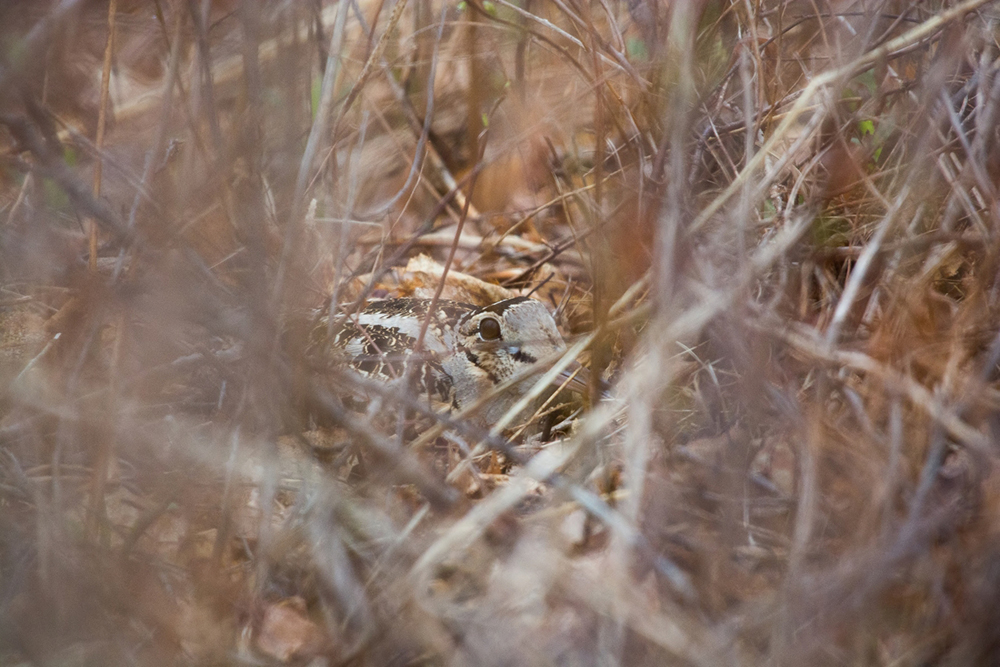
Woodcock are extraordinarily well adapted to remain undetected in their habitats. They crouch quietly and only flush at the last minute, lifting off in spiraling flight to avoid capture. American Woodcock, Ramos, Keith/USFWS, Public Domain, https://www.fws.gov/media/american-woodcock-0
After a couple of hurky-jerky twirls around the dance floor, the male woodcock flies up in a wide circle, spiraling higher and higher into the sky before diving back to the dance floor, making a sweet sound as it dives that ecologist and forester Aldo Leopold described as sounding like the call of a blue bird.
When I’m watching, I make my move as soon as the male takes off. I run as close to the spot I think he took off from and then stand stock still without a sound. The dancers almost always return close to the spot they took off from and if I am lucky, they will land within feet of me and start their strut. One movement, one whisper to a friend and they’re off to find another dance spot.
And dance and mate they do, all through migration according to researchers. The females choose their partner, then build a very simple ground nest in the alders or a similar site and dine mostly on earthworms, which they listen for and then use that knitting needle beak to retrieve from the muddy soil. Recent research shows that female woodcock may nest on the fly, too, with up to six broods a bird as she makes her way north.
I know this bird well. And its chicks, too, which are fluffy and patterned like zebras with a beak already like a needle. The chicks are precocial — meaning they crack out of the shell and start running around immediately on tiny twig-like legs and are fully independent about a month later. As a biological field technician for the US Fish and Wildlife Service, I followed woodcock for a year: live-trapping them and their young and releasing them after taking measurements to tell their age and gender. On some, I put tiny transmitters and followed their movements during breeding season to collect data that was later used to inform habitat management — important work, as their forest and grassland habitat has declined across much of their range.
Woodcock is one of the birds New England Forestry Foundation (NEFF) considers in its Exemplary Forestry standards and that the NEFF Western Maine Habitat Program staff plans for as we work with foresters and family landowners to improve native wildlife habitat in our partnership with the Natural Resource Conservation Service (NRCS) that prioritizes biodiversity and forest management. Woodcock are one of the species that need high-quality, early-successional patches of seedlings and saplings within larger forest blocks — a habitat type that is not common in Maine’s large forests.
As the woodcock are revving up in early March, but long before the peepers start peeping their song that sounds like a chorus of sleigh bells in May, wood frogs wake from hibernation beneath leaves on the forest floor and hop downhill to shallow half-frozen woodland pools and start to quack. These temporary forested wetlands, known as vernal pools, are made from surface water; they have no stream inlet or outlet and they dry up by late summer.
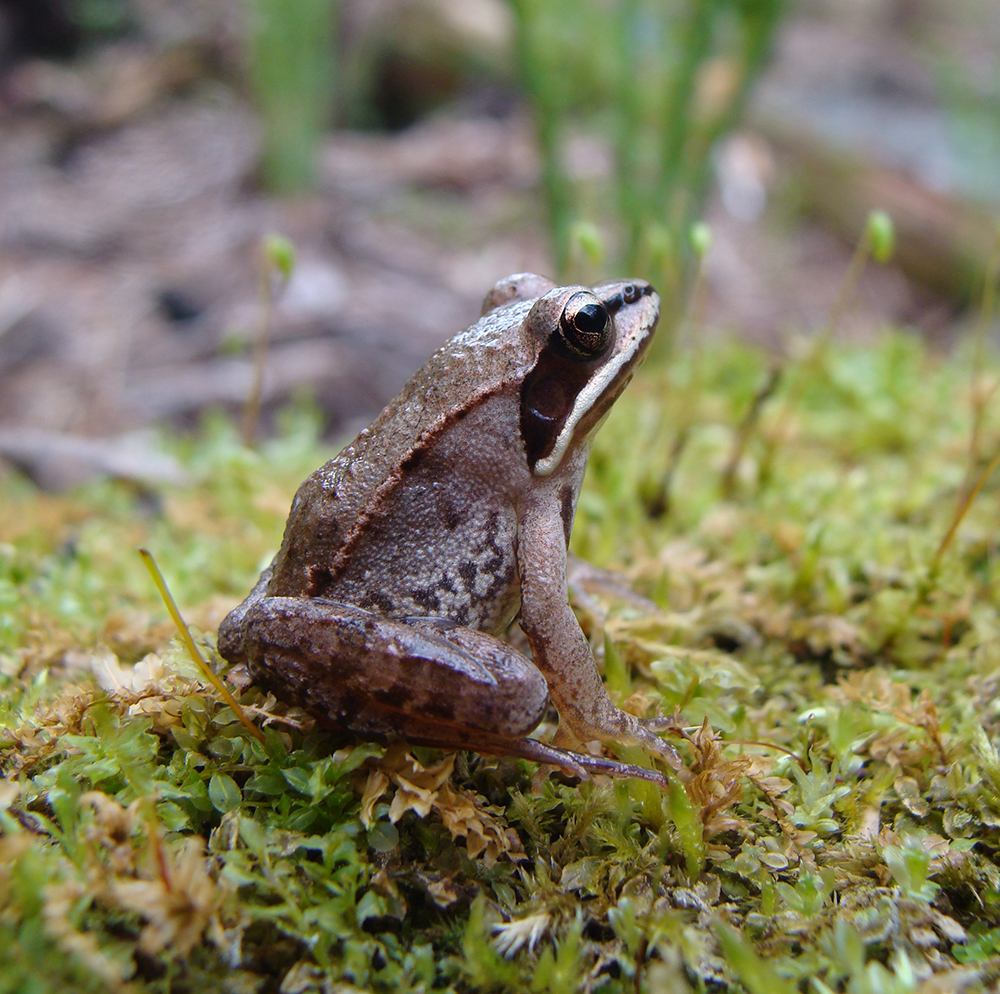
Wood frogs come to the pools to mate in late winter, long before we put our snow shovels away or spring officially starts. As soon as sap starts flowing in the maple trees, wood frogs are in the ponds making a call that sounds like a soft quack in the night. The breeding season is short and over before the better-known peepers, a small tree frog, start their night chorus. Photo by Dawn Morgan
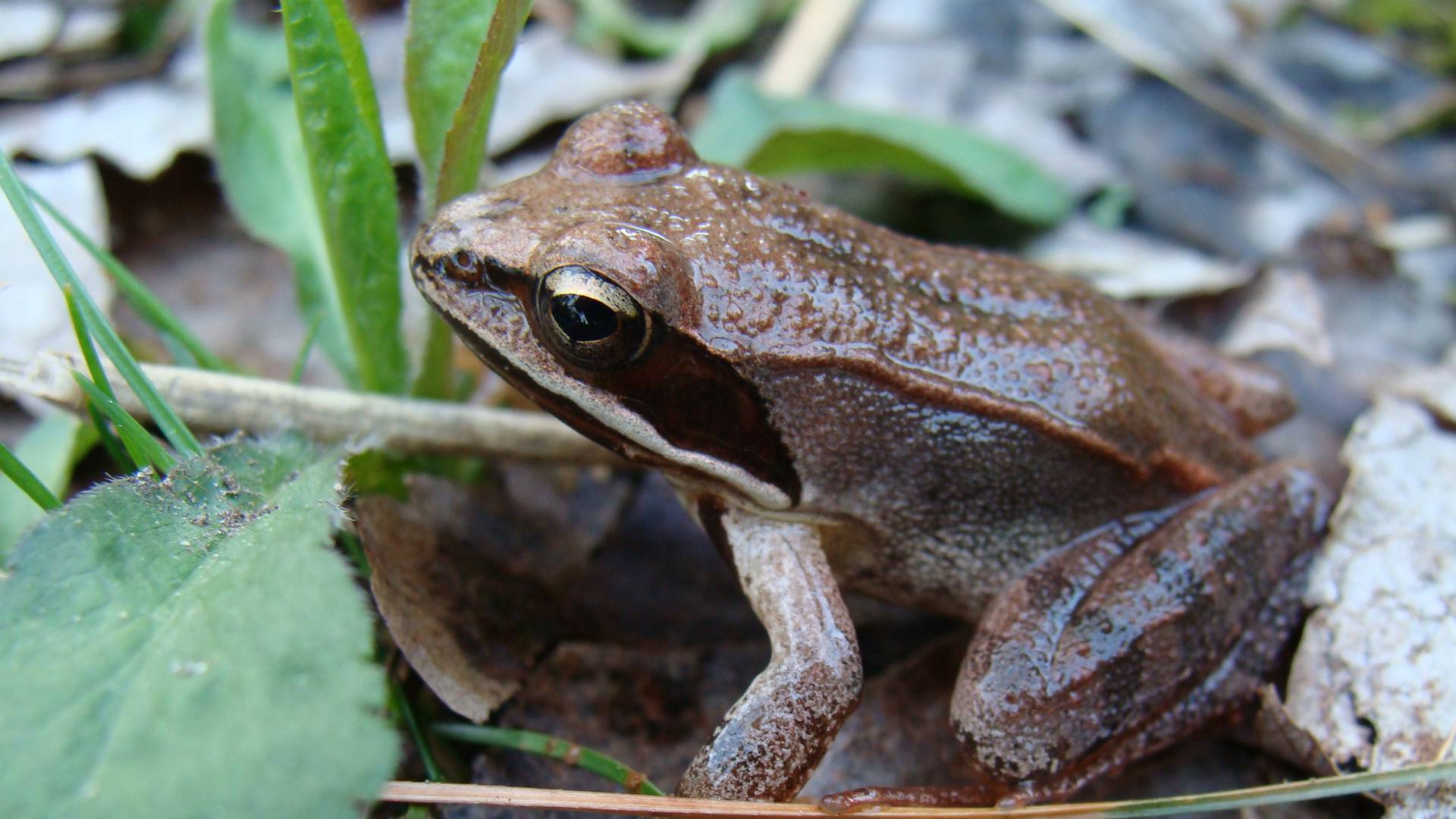
Wood frogs, which are a soft chestnut color and have a black mask that makes them look dressed up for a fancy masquerade, aren’t bothered by the ice. They can withstand freezing temperatures. As long as there is some water they quack at each other for a couple of weeks in March and are often mistaken for ducks when people hear them. Not many people do, unless they are driving by with their windows open or happen to be outside on a damp cold night. Be assured: it is rare to hear ducks quacking at night in the woods in mud season. An investigation the following morning will likely reveal a body of water that wood frogs find promising. Large lumpy masses of eggs that look like tapioca but are the size of a softball will be attached to twigs below the water surface if the wood frogs were successful.
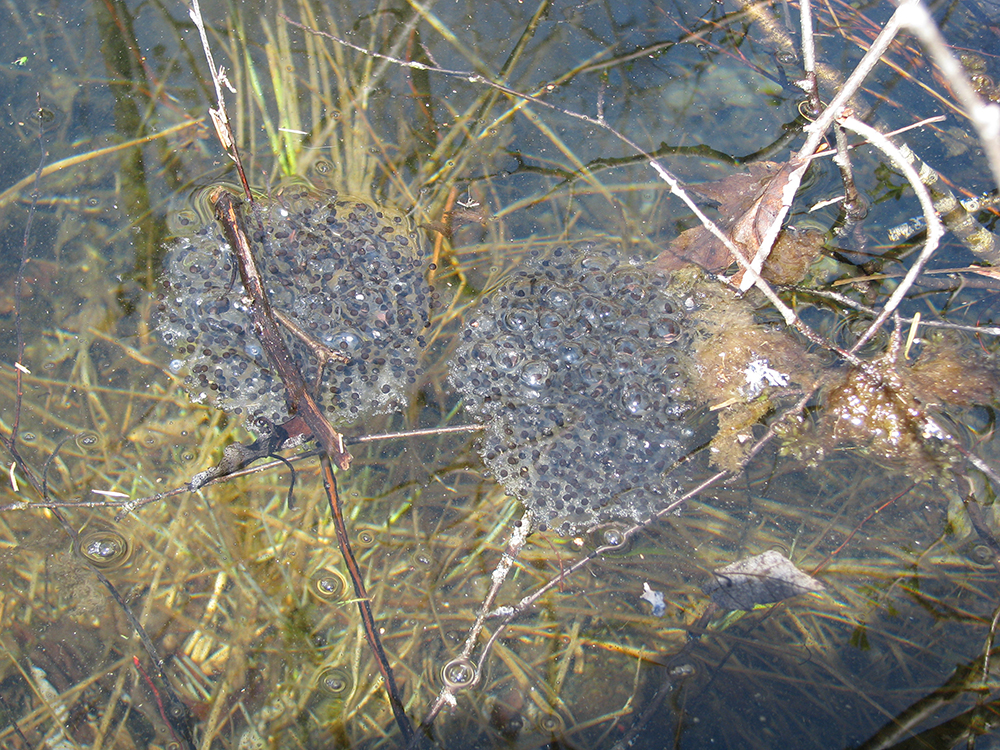
Wood frog egg masses, which are about the size of a grapefruit, are attached to twigs below the surface of the water. Unlike spottted salamander egg clusters, which are covered in a smooth sheath, the wood frog eggs are in a lumpy mass that look like large pearl tapioca. Photo by Dawn Morgan
Vernal pools are not the only place a wood frog will quack and breed but they tend to be a successful location. In fact, the definition of a vernal pool is biological: it is determined not just by being temporary, but also by having water long enough into the summer for four indicator wildlife species to breed and raise young: the wood frog, the (yellow) spotted salamander, the blue-spotted salamander, and the fairy shrimp — and by the lack of fish that would gobble up all the eggs. Like the wood frog, the spotted salamanders visit the pool to breed and lay dozens of lumps of eggs, each with the potential for thousands of offspring, then retreat uphill to their homes below ground beneath down trees in shady woods. Their egg masses have an extra layer of gel around the whole mass, thus making them smooth on the outside and distinctive from the eggs of the wood frog. The fairy shrimp is tiny and has a complicated enough life-cycle that it deserves a future story all its own.
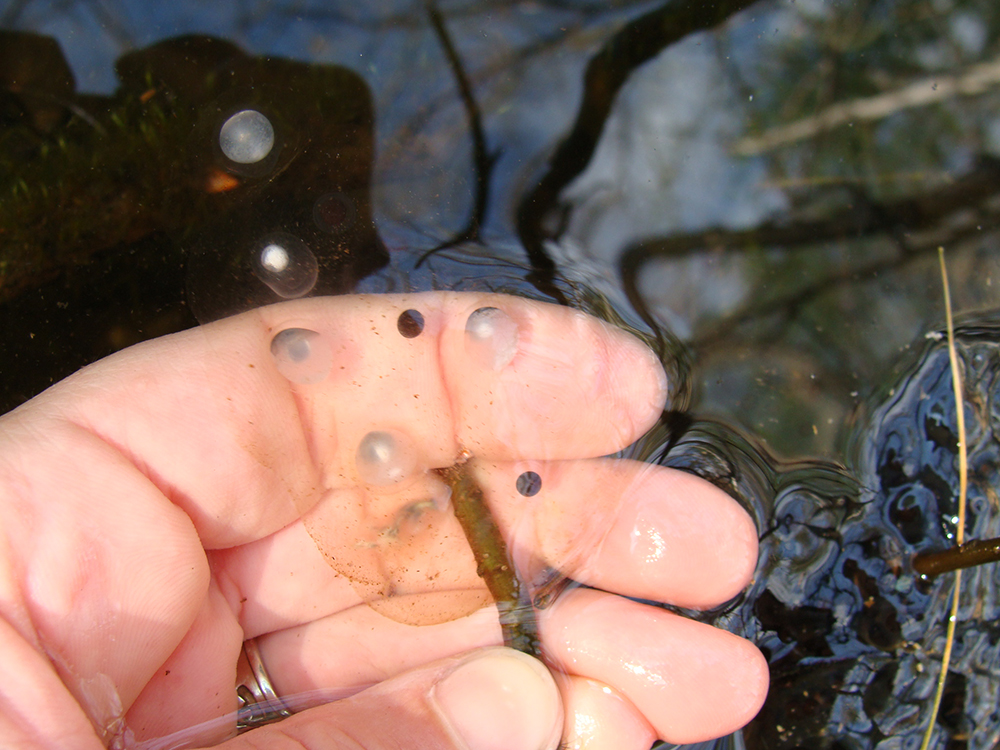
Blue spotted salamanders move to vernal pools from the uplands during the breeding season in very early spring. In the nearby upland they often live beneath fallen trees, or coarse woody material as it is referred to by the NRCS. it is rare to see them. They breed en masse in the pools, then return to the uplands. Their eggs, shown here, have a thick gelatinous coating that is smooth, unlike wood frog egg clusters. Photo by Dawn Morgan
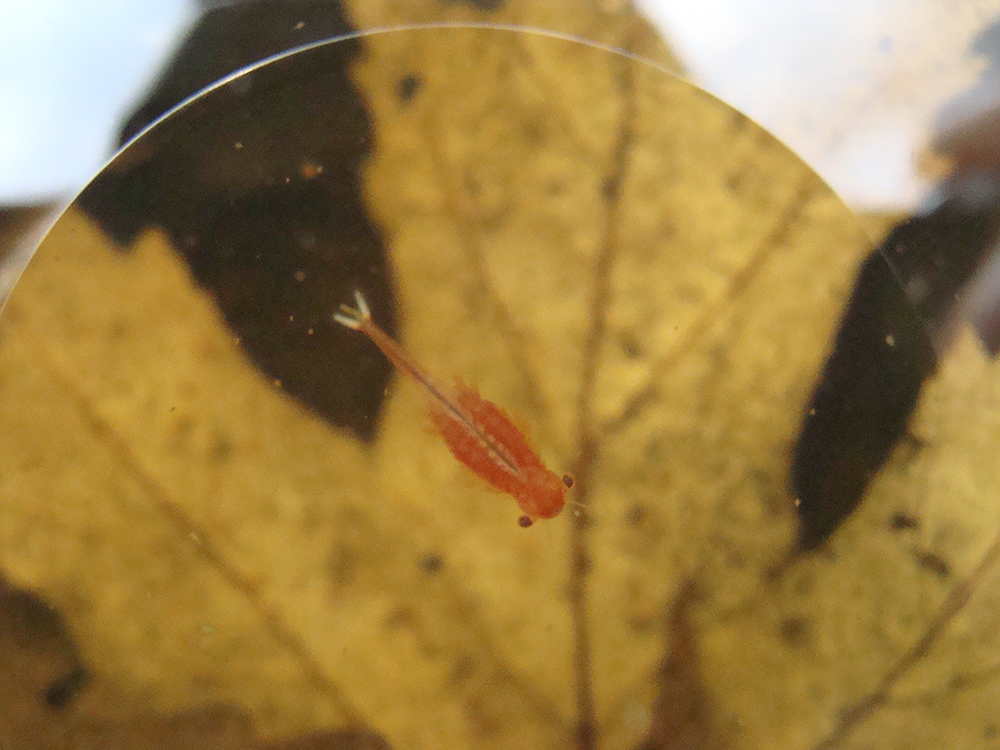
Fairy shrimp have a nuanced life cycle that deserves to be highlighted in a future NEFF blog post. They can complete their life cycle through deep freezes and summer drought in vernal pools and are an important food source for wildlife that come to vernal pools. Photo by Dawn Morgan
These four indicator species are only part of the vernal pool story. While fish can’t survive in a temporary pond and therefore are not predators of the Vernal Pool Four, the pools are packed with food for other hungry woodland wildlife who are breeding and raising young as spring turns to summer. On balance, if environmental conditions are favorable, the Four succeed at succession.
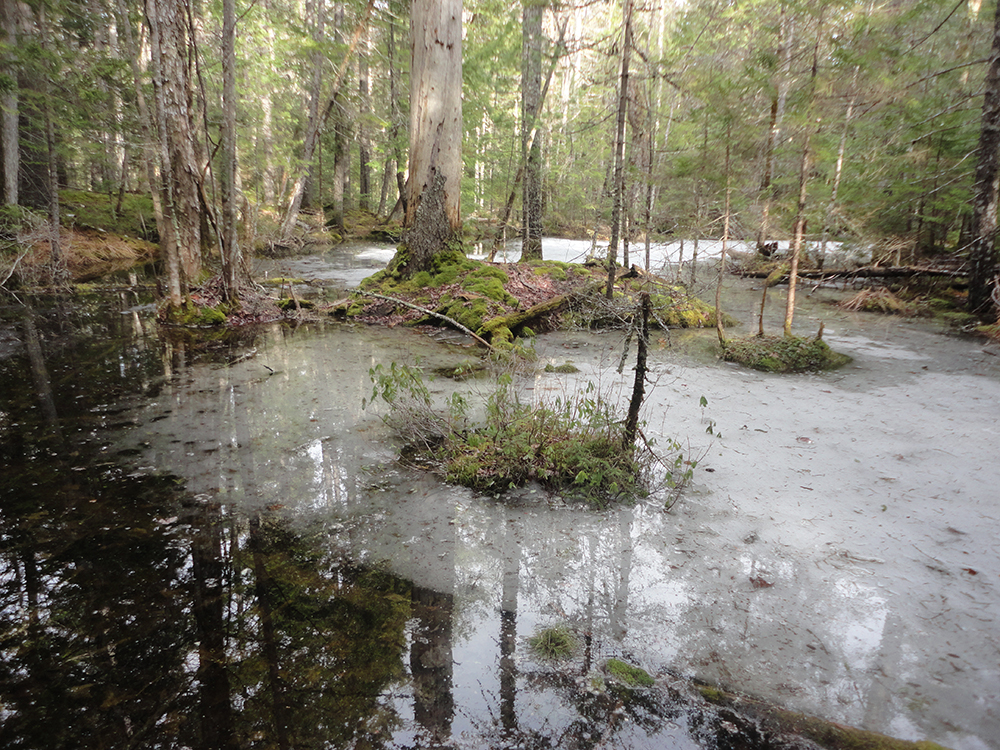
Vernal pools are temporary pools in shady woodlands that dry up by late summer. They are not ponds — they have no inlet or outlet — and do not provide sufficient habitat for fish to survive. With no fish predators, fairy shrimp, wood frogs and spotted salamanders have a chance to thrive — while their eggs also provide important food for other woodland wildlife raising families of their own. Keeping vernal pools shaded is an important consideration when crafting forest management plans that take wildlife into account. Too much sun dries the pools out too early for the life cycles of of the Vernal Pool Four to be completed. Photo Credit: Of Pools and People, www.vernalpools.me
The NEFF Exemplary Forestry standards are aligned with forest management recommendations for vernal pools provided by the State of Maine. Landowners and foresters are encouraged to retain 75 percent of forest canopy cover within 250 feet of vernal pools. In short, the goal is to keep the vernal pool area shaded and as undisturbed as possible while providing protection for the adjacent upland where the salamanders and frogs live. It’s also beneficial to leave downed logs and old and dying trees within the zone and minimize soil disturbance — or create new snags and logs (coarse woody material) where practical.
The NRCS, through NEFF’s Western Maine Habitat Program partnership, has reimbursed family and other private, non-commercial landowners to adopt forest management strategies that conserve vernal pools as part of a parcel-wide forest management plan. Notably, Maine adopted a new law in 2025 that created additional provisions for vernal pool conservation related to development.
I’ve been fortunate enough to put on hip waders and get wet up to my shoulders to count masses of wood frog and spotted and blue spotted salamander eggs for biologists at the University of Maine studying how best to conserve vernal pool habitat, so I have also gotten to know the Vernal Pool Four as neighbors do.
March yields its beauty for those who look and listen. The month of May may be the burgeoning chorus of the spring opera, and late April its aria, but March is the overture that establishes the mood and the tone of all that’s to come.