Stewarding the Future Forest at Sortwell Memorial Forest
May. 22, 2026
A planned timber harvest at Sortwell Memorial Forest will help guide the next…
Read More


Anyone who has been in the woods with NEFF Forester Mike Redante knows he can read the forested landscape like a historian, while also predicting what the forest will look like if this or that practice is implemented — or if none at all are implemented. Most good foresters can. But Mike can conversationally riff on the forest while he’s walking around, jumping over downed trees, balancing on stone walls, and assessing how he will tweak the next entry. If you are lucky enough to be out in the field with him, he can make the past and future forest visible and understandable, no matter how much you may know about forestry.
That’s a good model for what an effective demonstration forest can do — make the past, present, and future forest understandable, and explain how management and natural growth transform a forest — and that is what NEFF and its partners plan to accomplish on the new Rumford Community Forest in Western Maine.
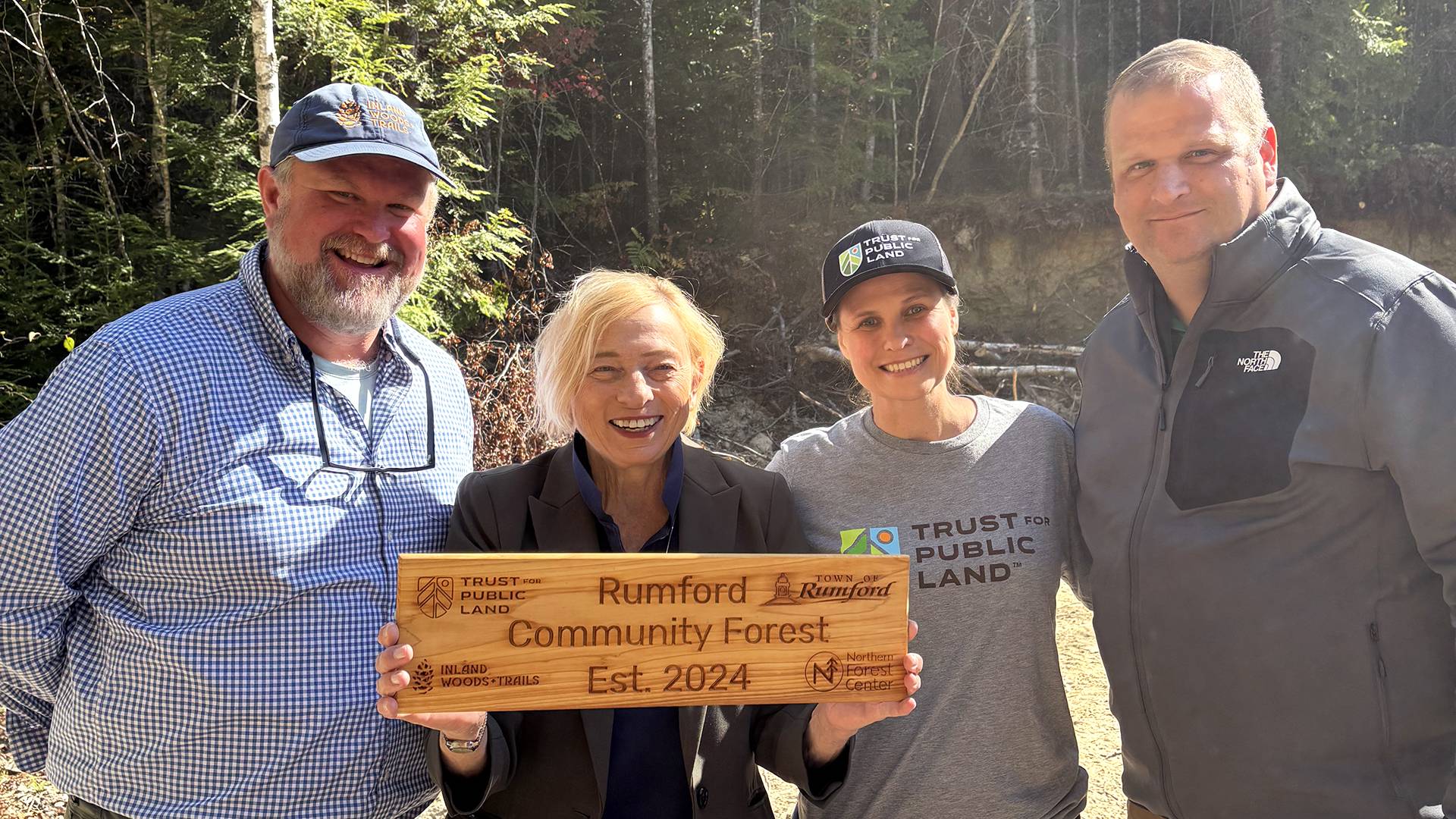
Three years ago the Rumford forest was slated for condo development when a town official and an angel investor who spent her childhood in Rumford started talking with Inland Woods + Trails (IWT), a local conservation and recreation organization, about conserving the forest for public outdoor recreation and biodiversity values. With help from private individuals, the Trust for Public Land, the Northern Forest Center, and other partners, the team successfully sought public input and then fast-tracked buying and establishing the 446-acre community forest in under two years.
An ecological assessment plan, a recreation plan, and an initial forest management plan followed. Trails for hiking, biking, cross-country skiing, and snowshoeing are now being established.
The grand opening of a completed All-Use trail — a short, level, smooth trail accessible to those pushing strollers or using wheelchairs — opened with a ribbon-cutting by Maine Governor Janet Mills in September 2025.
While recreation is the primary focus of the IWT mission, sustainable forestry is integrated into their approach. NEFF’s Western Maine team worked with IWT, their foresters, and our project partner, the Natural Resources Conservation Service (NRCS), to tailor active forest management aligned with NEFF’s Exemplary Forestry approach to the property. Once the forest management plan was complete, NEFF continued working with IWT’s foresters to provide technical oversight and access to financial assistance from the NRCS to help implement the forest practices on the ground.
IWT, the new owner of the Rumford Community Forest, agreed to set aside part of the property for NEFF to turn into a trail that demonstrates Exemplary Forestry as it’s implemented in NEFF’s Western Maine Habitat Restoration Program.
Since foresters are not like elves, popping out from behind trees to answer questions whenever a casual hiker, curious landowner, or forester looking to develop new skills has a question, forest signage is an increasingly adaptive alternative for demonstration forests. For example, QR codes on signs can be scanned with a mobile phone and link to additional and specific information about the forest practices, expected outcomes, and wildlife habitat and climate considerations specific to a stand. With a good internet connection, the QR can lead to an informative video or a wildlife cam. If no cell signal is available, QR codes can point to links or contact information for use later.
The QR codes make the educational signage more dynamic. As the forest stand grows or changes over time as a result of management, the QR-connected links can be swapped out and updated remotely from NEFF’s central office without altering the sign.
Eye-catching graphics of forest structure from the canopy to the forest floor, highlights of native wildlife species like spotted salamanders and American marten, or QR codes linking through to a quick video clip of a NEFF forester explaining the value of creating small gaps or managing beech are just some of the options available as NEFF’s Western Maine Project staff work with their community forest partners to develop a site-specific and interactive educational experience.
The next step of telling the story of Exemplary Forestry in northern New England’s Acadian Forest is underway. With funding from the National Fish and Wildlife Foundation, NEFF is working with IWT to develop one or two trails that demonstrate NEFF’s Exemplary Forestry approach. Advisory assistance from Maine Audubon’s Forestry for Maine Birds program strengthens the effort.
In 2022, NEFF’s Western Maine team and Maine Audubon collaborated on our first demonstration forest trail in Bethel on the McCoy-Chapman Forest owned by Mahoosuc Land Trust.
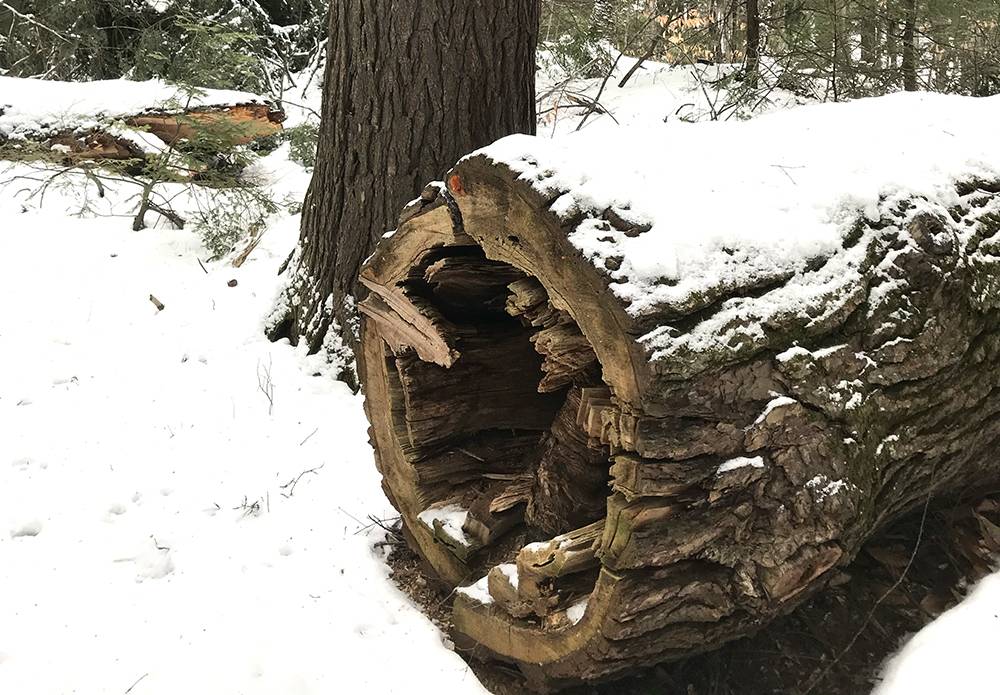
Our goal in Rumford is three-fold. First, as the Maine Audubon image illustrates below, we plan to provide a basic introduction to habitat features in a forest, including the ecological roles that standing dead trees, downed logs, and the structural layers of forest floor, mid-canopy, and forest canopy play within the forest.
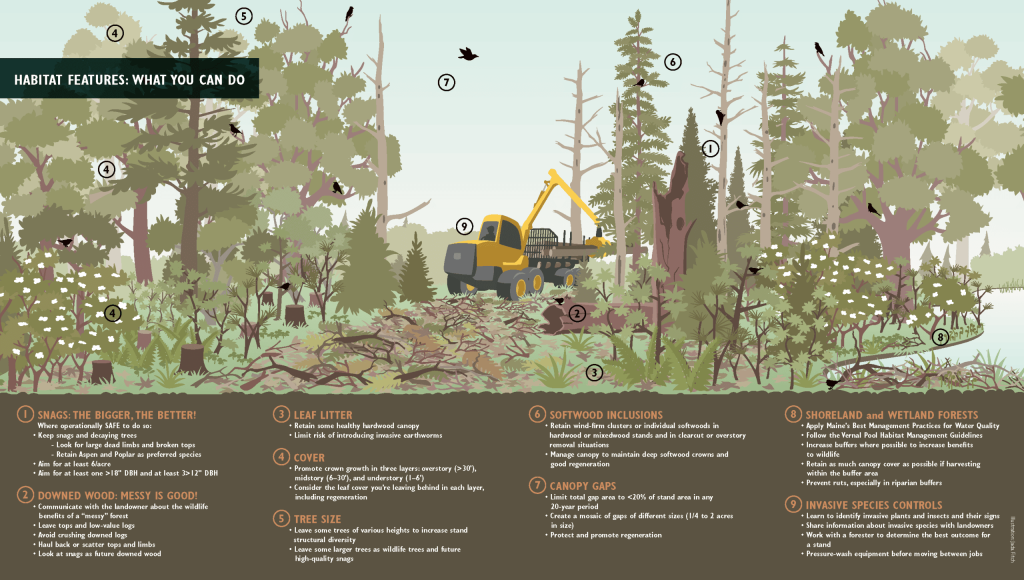
Forestry for Maine Birds/Maine Audubon
Second, we plan to provide a deeper look into specific forest management practices that foster a healthy, diverse forest that offer the widest range of native wildlife habitat features — both on the target forest and in the surrounding landscape — while also enhancing climate values and growing more and better-quality wood over the long term.
And third, we want to extend the learning opportunities beyond Rumford and foster an understanding of what NEFF Exemplary Forestry looks like when applied in real time on the ground. To that end, the NEFF team plans to create a sign template for NEFF Exemplary Forestry that can be easily adapted for use on any of the NEFF Community Forests that Mike tends to across New England.
The demonstration forestry trails will be completed on the Rumford Community Forest by 2027.