Stewarding the Future Forest at Sortwell Memorial Forest
May. 22, 2026
A planned timber harvest at Sortwell Memorial Forest will help guide the next…
Read More


In late September, I joined NEFF Staff Forester Mike Redante for a visit to NEFF’s True Farm Living Forest in Mechanic Falls, Maine. Mike was meeting with a crew from the Maine Conservation Corps (MCC) that had been working on a multi-week timber stand improvement project — an effort that not only strengthened the health of NEFF’s woods but also gave a new generation of conservation leaders invaluable, boots-on-the-ground forestry experience.
Established in 1983, the Maine Conservation Corps is an AmeriCorps program designed to build environmental leadership while stewarding lands and communities across the state. MCC members, many of whom are students or recent graduates, commit to months of field service that blend hard skills, teamwork, and exposure to conservation careers. Their projects — trail building, invasive species removal, habitat restoration, and forest stewardship — continue the legacy of the Civilian Conservation Corps of the 1930s.
This fall, a six-person MCC cohort arrived at True Farm to take on one of the most hands-on tasks in NEFF’s Exemplary Forestry toolkit: timber stand improvement (TSI). For eight weeks, they worked across 30 acres, moving methodically through the woods in grids. Equipped with saws, loppers, flags, and an eagerness to learn, they identified crop trees*, pruned to improve structure, opened up crown space, and reduced competition from poorly formed, suppressed, or diseased trees.
“It’s rare to have this many helping hands focused on careful, thoughtful timber stand improvement,” Mike said as we walked the property. “Their contribution was huge for True Farm, and for advancing Exemplary Forestry on our Community Forests.”
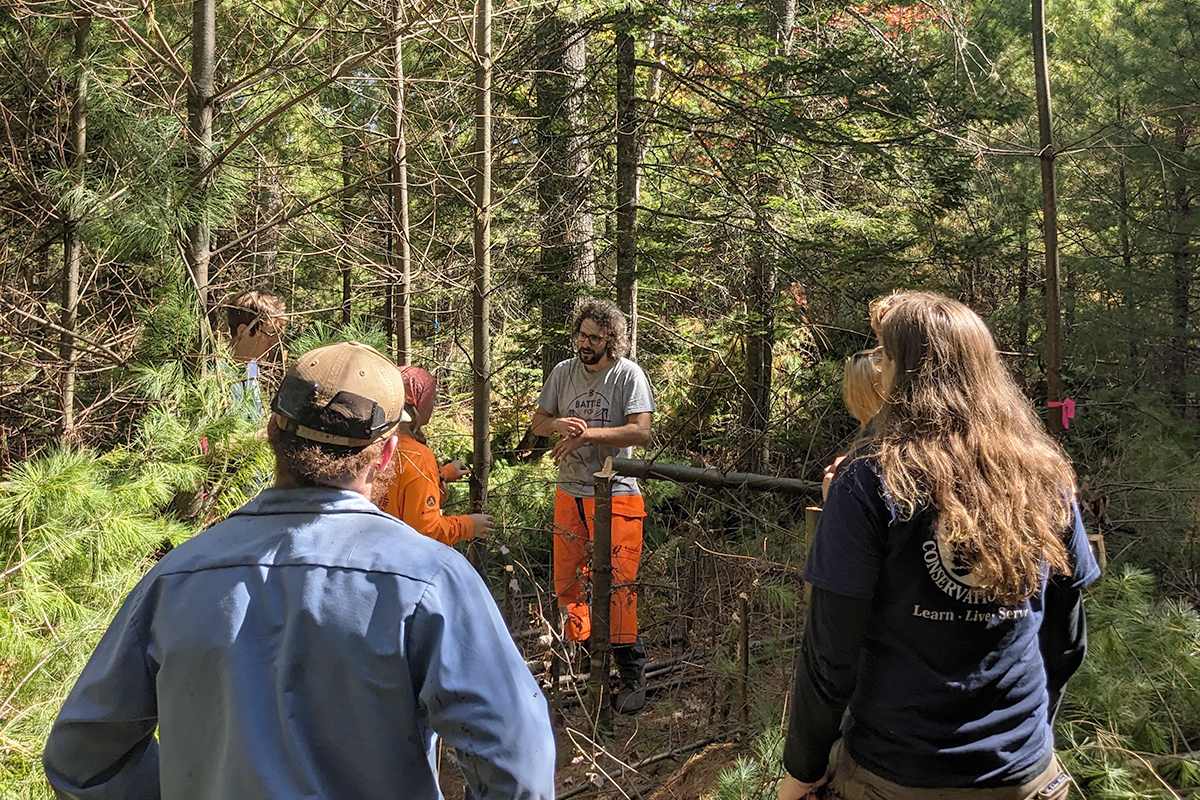
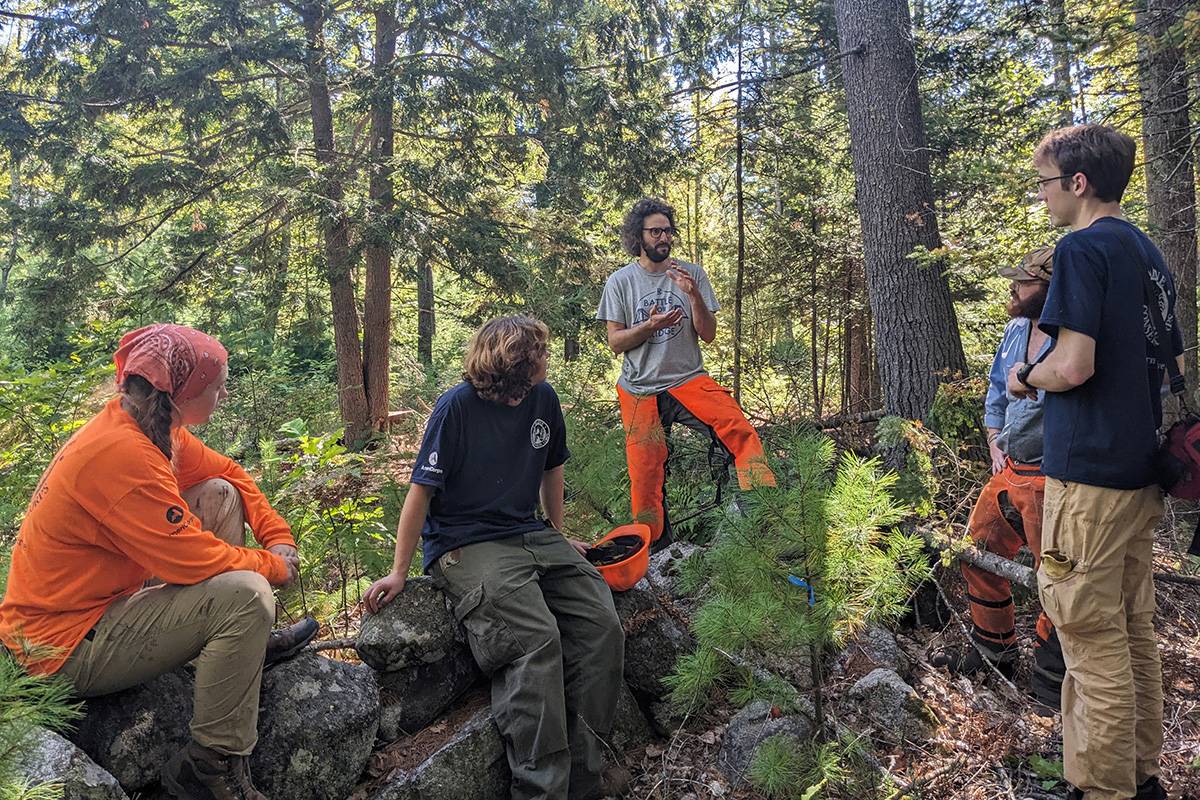
NEFF Staff Forester Mike Redante responds to a question about felling low-quality, small-diameter trees across a broad forest area. Photo by David Ayers.
While the work was essential for NEFF, it was equally transformative for the crew. During a break, I sat with five of the members to talk about their backgrounds, what they were learning, and where they hoped this experience might take them.
Finn, the team leader, spoke with striking clarity about why this work matters. Originally from Appalachia, he grew up around the lumber industry and saw forestry as both culture and craft. After a stint in AmeriCorps’ National Civilian Community Corps, he was drawn toward conservation and eventually to MCC.
“Learning how to grow beautiful timber trees is just cool,” he said. “You have to think 70 years ahead. Being out here, doing it with your hands, makes everything click.” A former welder, he sees forestry as a career he may potentially want to pursue.
Ishmael came to MCC after living in Washington state. Following a recommendation from his brother Finn, he moved to Maine seeking something new. What he found was both familiar and eye-opening.
“Parts of Maine remind me of Virginia, where I grew up, and parts feel like Washington,” he said. “And some of it is completely unique. I’ve been enjoying it.”
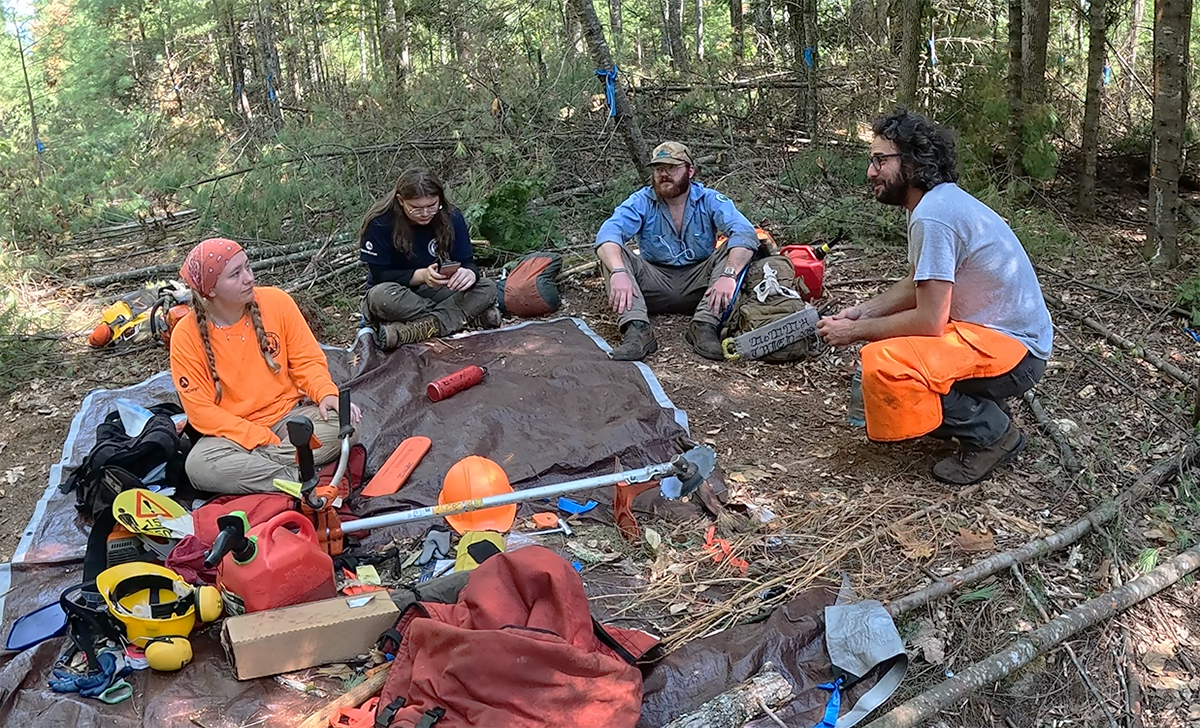
NEFF Staff Forester Mike Redante meets with MCC crew members during a mid-day break at base camp. Photo by David Ayers.
Sierra’s path began far from the Maine woods. Raised in the Texas Hill Country, she switched from business school to environmental studies after a life-changing backpacking trip. She applied to nearly 90 conservation corps positions, and MCC was the first to respond. The ecological transitions — from junipers and oaks to Maine’s mixed northern forest — have been fascinating.
Her family owns 300 acres back home, and she hopes to eventually manage part of it for the endangered golden-cheeked warbler. “What I’m learning here feeds right into what I want to do,” she said.
Topher, fresh out of college with a degree in politics, philosophy, and economics, joined MCC to explore environmental work before deciding on a career path. Growing up in western Massachusetts, he appreciated being close enough to visit home while gaining practical field experience.
Chloe, from Littleton, Massachusetts — just down the road from NEFF’s headquarters — came to MCC after gap years during the pandemic and a growing desire to help the environment. Now a student at Unity College, she said what mattered most was finding a job she wouldn’t feel the need to take a vacation from, something she hoped and felt could be achieved through a career rooted in the outdoors.
TSI may not have the immediate visual impact of a major harvest, but it is one of the most important long-term investments NEFF can make in its forests. By pruning, thinning, and releasing high-quality crop trees, foresters shape healthier, more resilient stands with stronger timber value, improved wildlife habitat, and better structural diversity.
For the MCC crew, this meant learning to read the forest — understanding which trees to favor, which to remove, and how sunlight, spacing, and competition shape the stand’s future. It also meant applying chainsaw and pruning skills in real conditions, with real ecological consequences.
While not everyone arrived with chainsaw experience, what stood out was the crew’s communication and coordination. By the time of our visit, their teamwork was evident: Topher moved ahead, flagging crop trees and competition; Finn followed, cutting or girdling where appropriate; and the rest of the crew worked steadily behind them, pruning stems and improving form.
Each person had a defined role, and together their movements created a smooth, efficient flow through the woods. It was an orchestrated effort, one that showed both their growth over the season and the value of collaborative, hands-on stewardship.
As we walked, Mike noted how valuable it would be to welcome this crew back in future seasons. With the skills they’ve gained — and ideally with a few more trained sawyers — he said they could move even more efficiently through the remaining TSI work at True Farm and other NEFF forests.
“They’ve built a strong foundation this year,” he said. “If they came back with that experience under their belt, plus a full team of saws, we could make really quick work of what still needs to be done.”
The partnership between NEFF and the Maine Conservation Corps highlights a simple truth: forest stewardship spans generations. The work we do today shapes the forests that will stand tomorrow. At True Farm Living Forest, that stewardship was already taking root — each member of the MCC crew leaving a quiet but meaningful mark, tree by tree and decision by decision, regardless of where their careers ultimately lead.
As we left the stand, late-afternoon sun slipped through the newly released crowns, brightening patches of ground that had been in shadow for years. Nothing dramatic — just the quiet, incremental change that defines good TSI work. The MCC crew may move on to new projects or different careers, but their time at True Farm is now etched into the structure of this forest in a way that will matter well beyond this season.
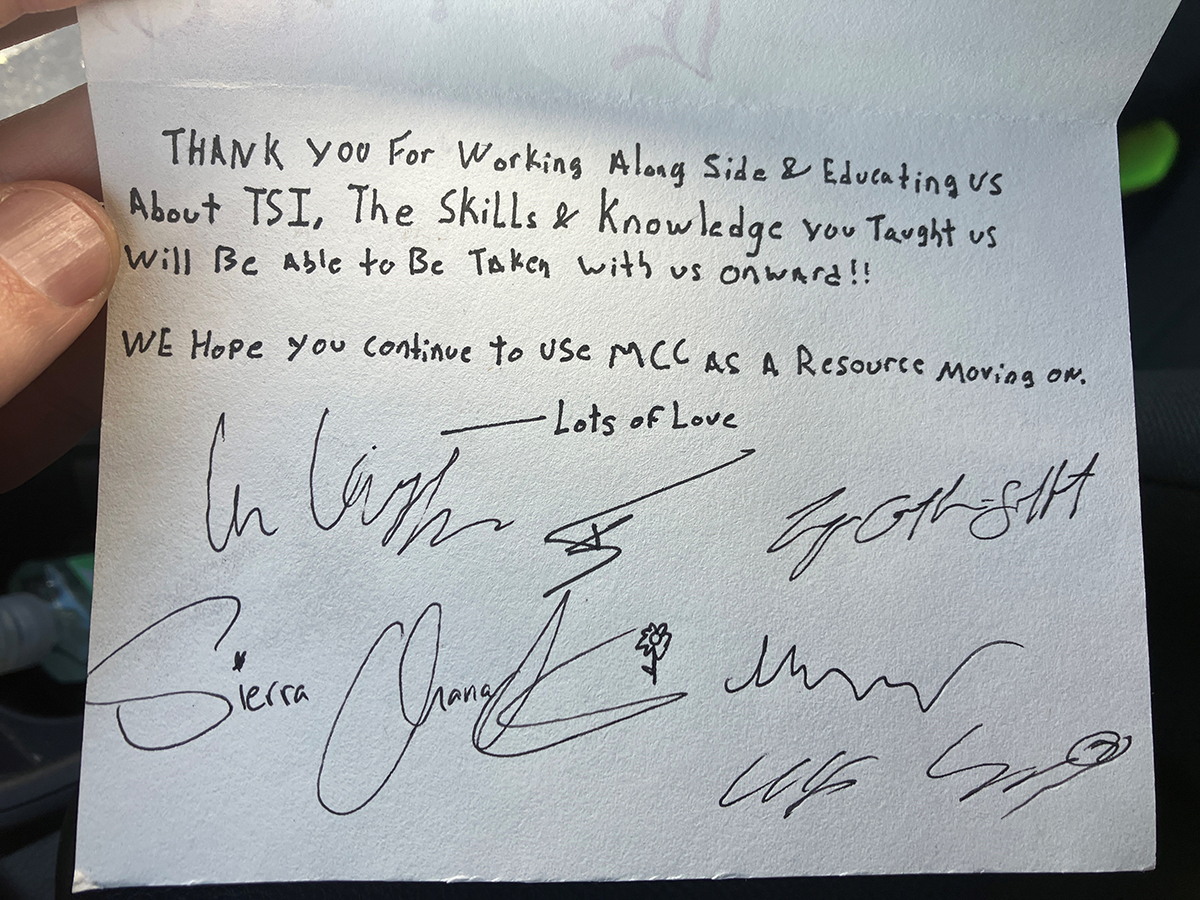
The MCC crew surprised Mike with a heartfelt thank-you card after their summer of TSI at True Farm. Photo courtesy of Mike Redante.
*A crop tree is a healthy, vigorously growing, straight tree that a forester selects to grow bigger and faster for the future to produce high-quality, high-value timber. Competing trees are carefully removed so the crop tree canopy gets more sunlight, space, and nutrients to thrive.