Meet the American Beech
Jun. 11, 2025
Learn about the American Beech's life history, cultural uses, ID tips, and more
Read More


In wonky forester speak, most of the deciduous woods stretching from southernmost Maine to the coast of Connecticut and Rhode Island are “oak-hickory forests.” This name, logically enough, comes from the two genera of trees that dominate here, but the oaks really hold the senior position in this partnership. Demand for oak timber from our region’s sawmills is many times higher than for hickory, and as a result, vastly more effort has been put into understanding how to grow oaks in New England forests. Despite hickories’ ubiquity, the forest sector has largely relegated them to being oaks’ loyal but mostly neglected sidekick.
That’s too bad, because they not only provide diverse forest values, but also take care of themselves very nicely! It is notoriously hard to regenerate red and white oak in New England because their seedlings are outcompeted by more shade tolerant species in the understory and they are brutally browsed by grazing deer. This problem gives foresters heartburn across our region! But recent research on hickories suggests these species quietly accumulate healthy populations of seedlings in the understory, and with time can gradually become more and more abundant in the forest. Hickory has a plan for the long run!
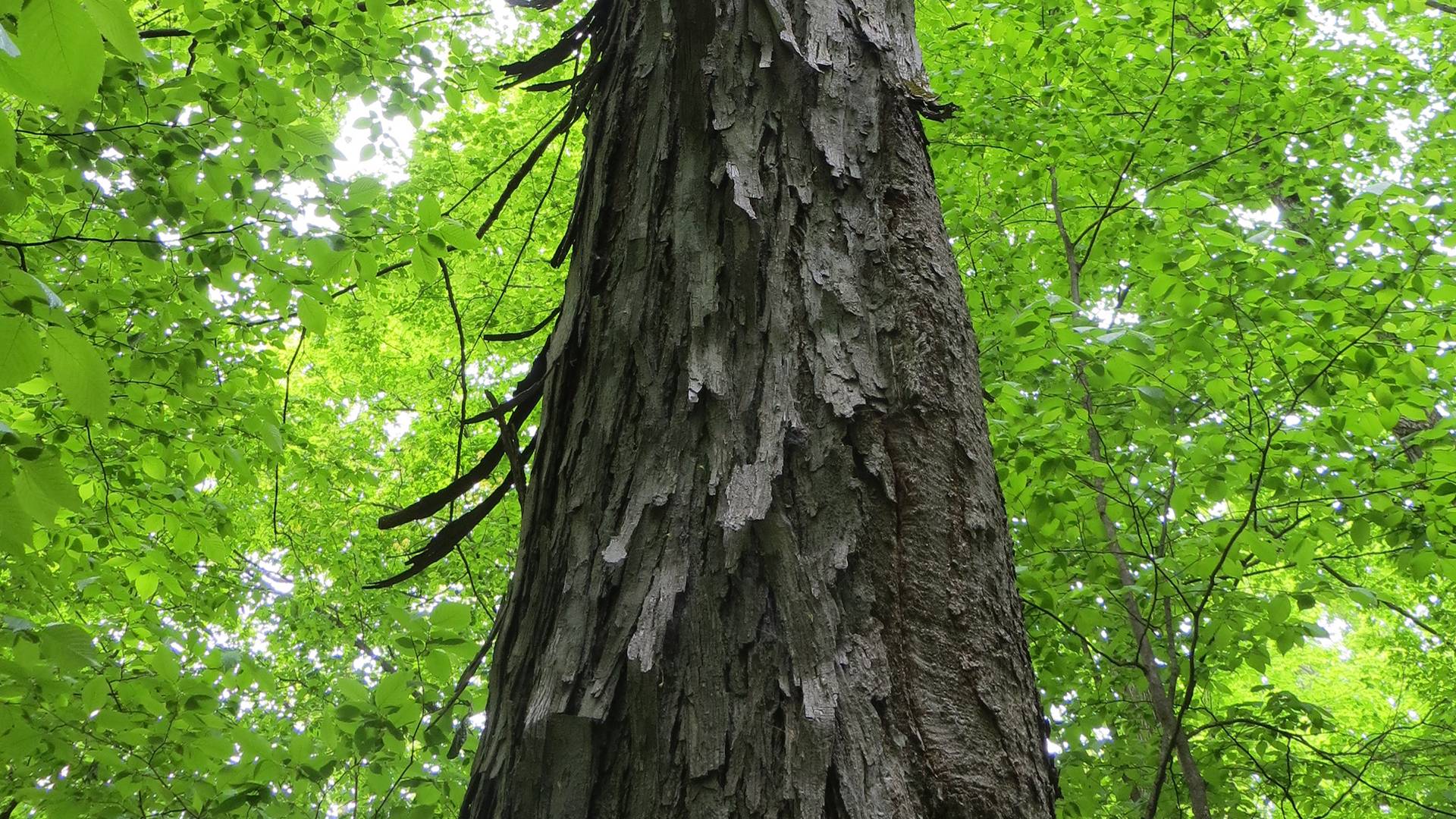
There are five species of hickory in New England, out of 11 total in the United States, but the most abundant by far is shagbark hickory (Carya ovata). The common name of this tree tells us the easiest way to find it in the forest: its bark forms pointed strips that curl marvelously off the trunk, creating a shaggy silhouette. Other hickory species lack this feature, and the only other New England tree that can occasionally compete in shagginess is a very old red maple.
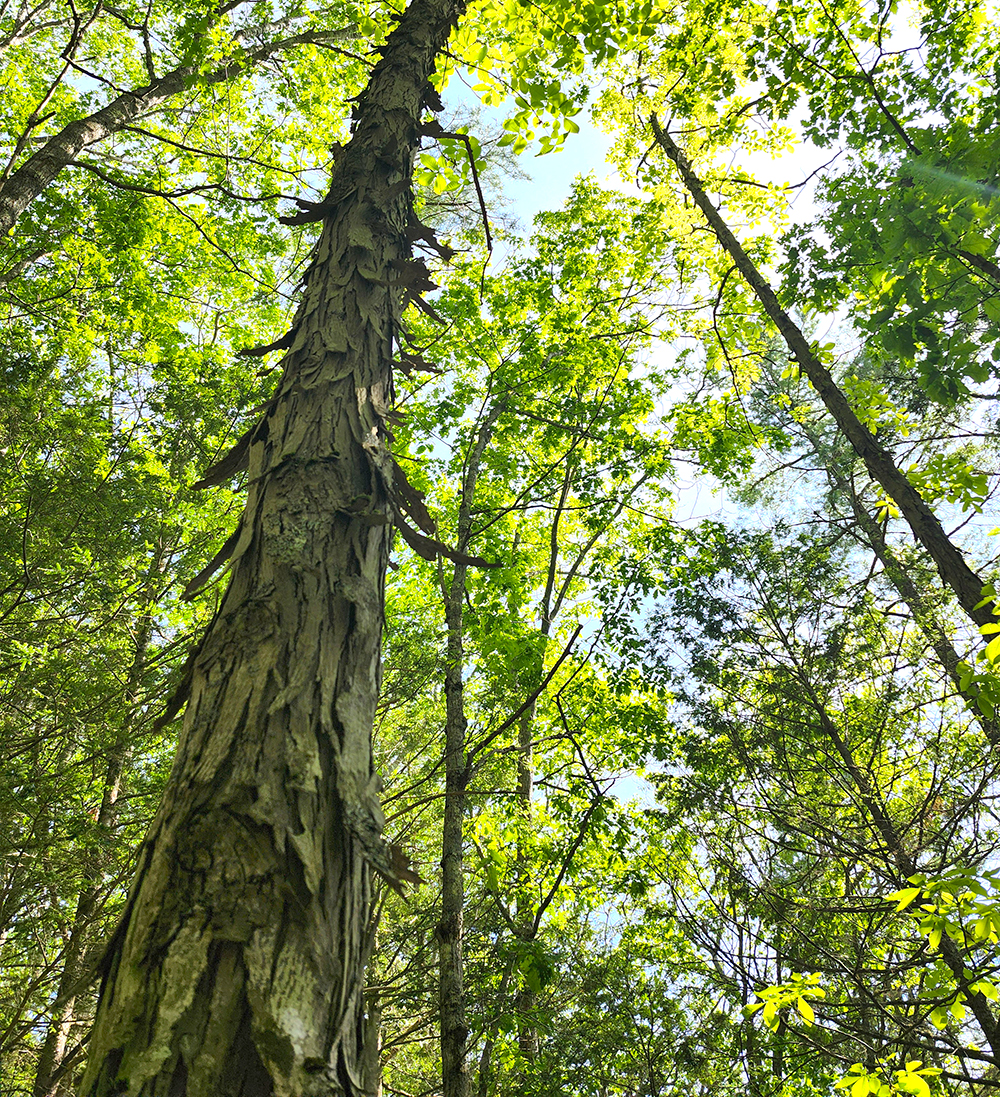
Photo by B. Milakovsky
Other identifying features of shagbark hickory include its compound leaves — meaning many small leaflets on a single stem — and its large nuts, produced every 1-3 years, which are contained inside a thick husk.
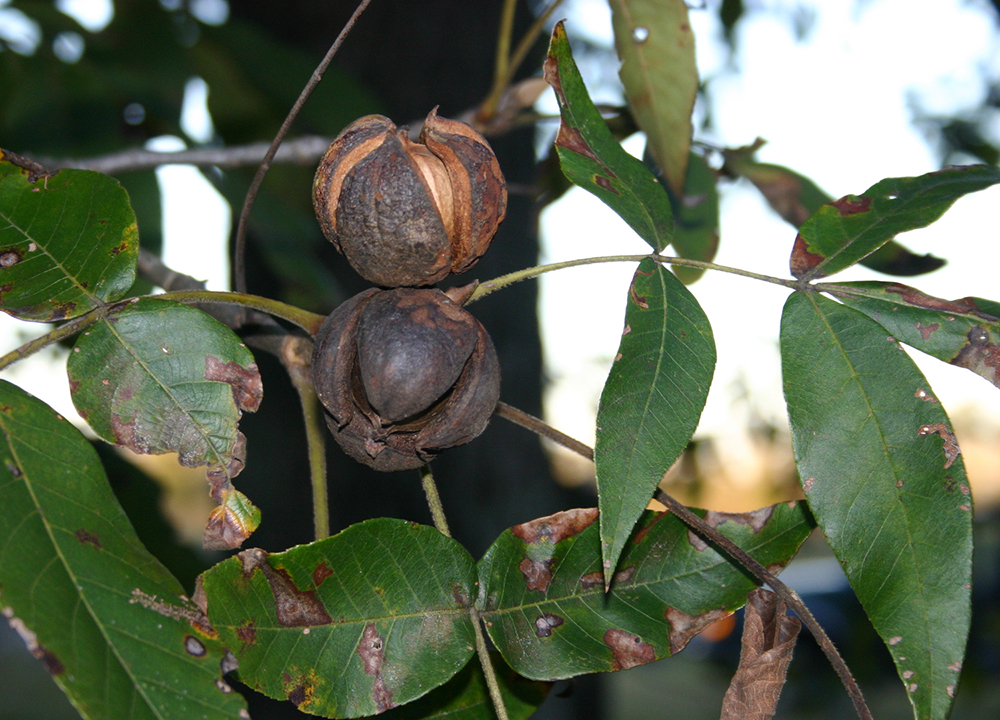
Ripe shagbark hickory nuts, ready to fall. Media Commons: Photo by Abrahami, CC BY-SA 2.5, license: https://commons.wikimedia.org/w/index.php?curid=1526491
Shagbark hickory can grow as tall as 120 feet, though in New England it is more likely to top out at 70-90 feet. Mature hickories in our region can reach two feet in diameter, and diameters of up to 3.5 feet have been recorded.
Hickories are a fairly common sight in southern New England, but even in Connecticut, where they are native to every county, all the hickories together only make up a few percentage points of total standing tree volume. Compare this to the most “hickoried” state, Kentucky, where that figure is 9-11 percent. Indeed, the true homeland of the hickories is the southern Appalachians.
Shagbark hickory declines in abundance as one moves north in New England, petering out in central New Hampshire and Vermont where it avoids the cold slopes of the Green and White Mountains. In Maine, it is found in only the four southernmost counties. But this species also has enormous potential to expand its range as the region’s climate warms.
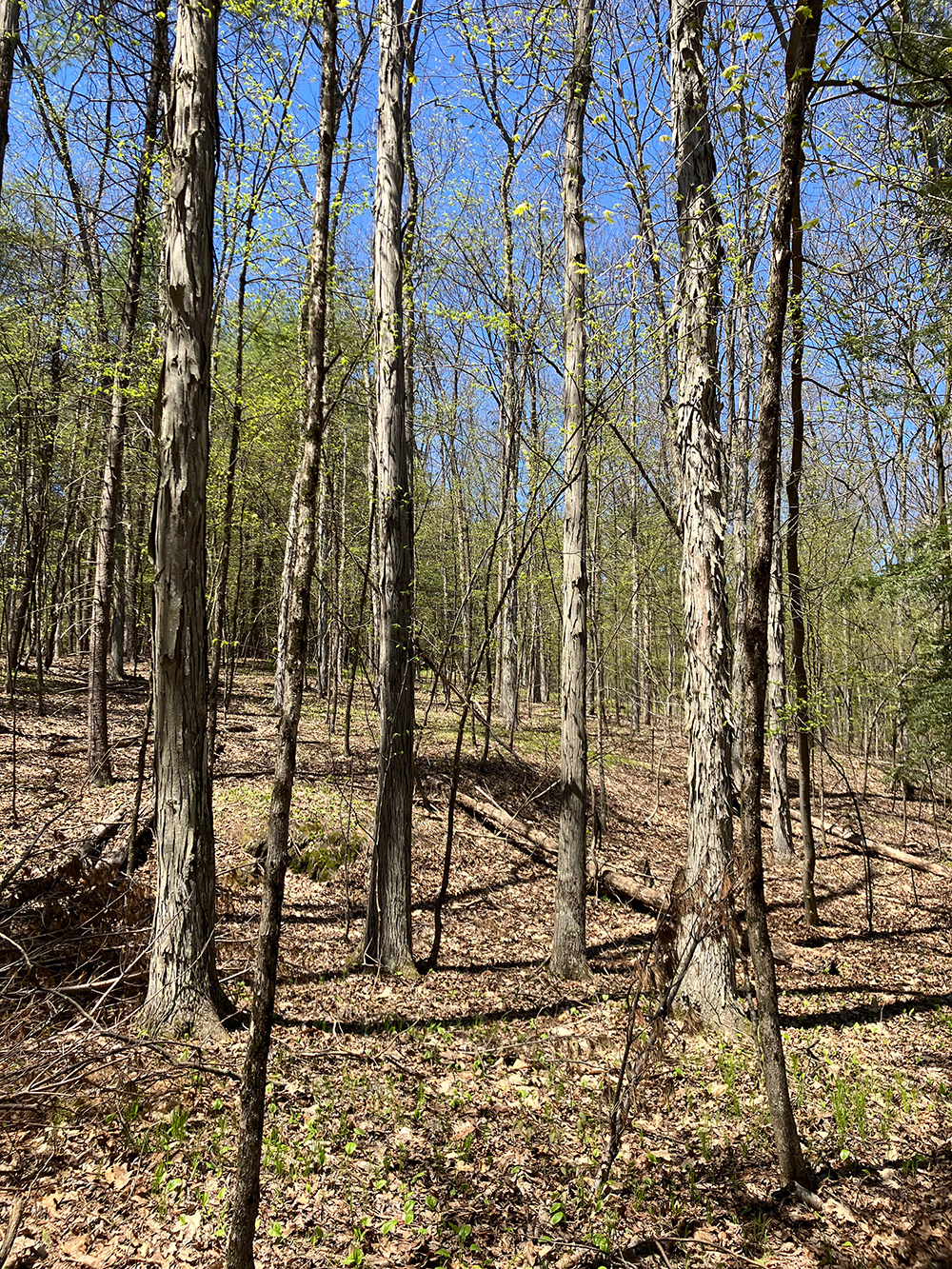
Shagbark hickory on NEFF’s Lucky Dog Forest in Buckland, Massachusetts
NEFF’s Senior Forester Brian Milakovsky lives in Bath, Maine, near the mouth of the Kennebec River, which is the location of the northernmost wild shagbark hickory trees in New England. They grow in fairly typical local soils, regenerate very well, and have excellent form and health. All this suggests that they could occupy a much larger area than they currently do, and potentially significantly farther to the north. Foresters should consider assisting shagbark in its northern expansion by scattering its nuts in natural treefall gaps or harvest areas in oak-dominated forests.
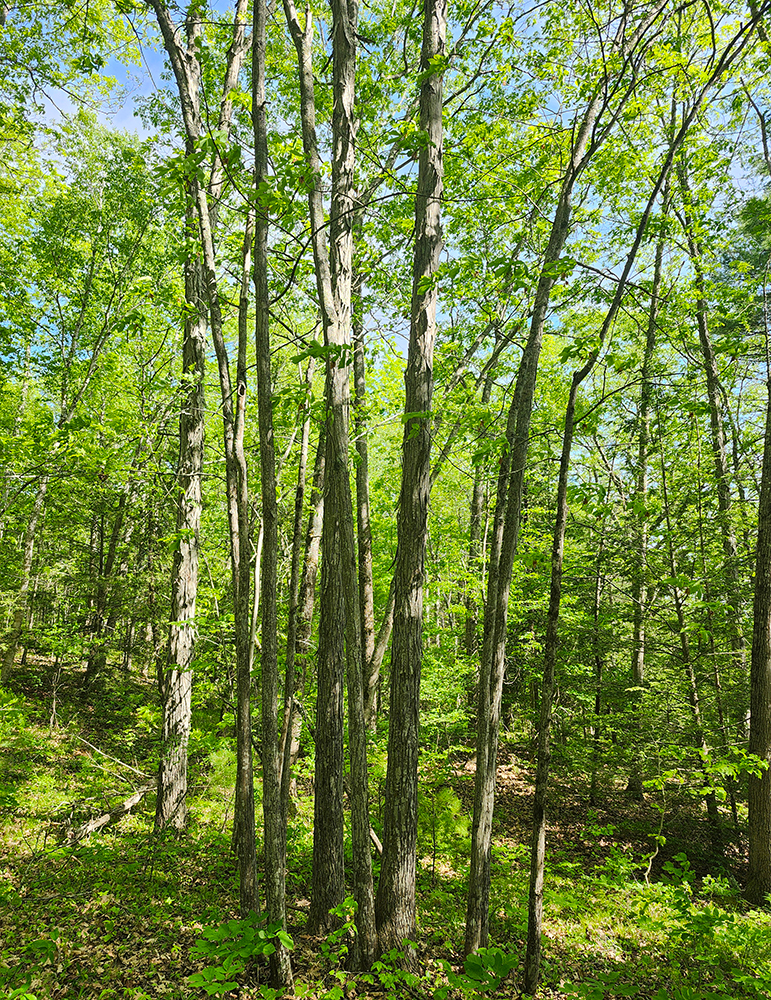
Possibly the northernmost wild shagbark hickory trees in the United States, in Bath, Maine. Photo B. Milakovsky
And why would we want more hickories around? True, in New England, hickory wood is in less demand than oak and is only sometimes purchased by specialty sawmills. That said, its wood is well known farther to the south for flooring, furniture and tool handles. It is perhaps more famous for smoking meats (“hickory smoked bacon,” anyone?) and is superb firewood.
It is likely that New England’s wildlife would value hickory far more than its humans, for hickory nuts are a key food source for grey squirrels and chipmunks, whitetail deer, black bears, wild turkeys, foxes (!), and even several species of ducks. As oak species face increased mortality from the exotic spongy browntail and winter moths in New England and hence produce less nutritious acorns, shagbark hickory can help supplement food resources in the woods for wildlife. People should give the nuts a try as well, for they resemble in taste pecans, which are themselves a species of hickory!
Finally, shagbark hickory is simply a delight to the eye. Besides its distinctive bark, its foliage turns a wonderful mixture of copper, orange, and yellow in the fall, resembling a smoldering fire. One of the best ways to find this tree in New England’s forests is to search out this beautiful late fall color.