A Forester, an Entomologist, and 500 Beetles Walk Into the Woods
Jan. 28, 2026
To control the invasive hemlock woolly adelgid, NEFF released 550 biocontrol…
Read More


The American Beech (Fagus grandifolia) is one of the most common deciduous trees in New England and forms part of the trifecta of species that dominate most of our mountainous landscapes, together with Yellow Birch and Sugar Maple. We call these the “northern hardwoods.”
Beech is all around us, but we should not take it for granted. Few other tree species in our region have suffered as much from the exotic pests and pathogens that are so disproportionately common in the northeastern United States.

American Beech stand, Brian Milakovsky
It is found throughout the eastern United States and Canada, as far west as Ohio, and is even found in some of the mountainous provinces of Mexico.
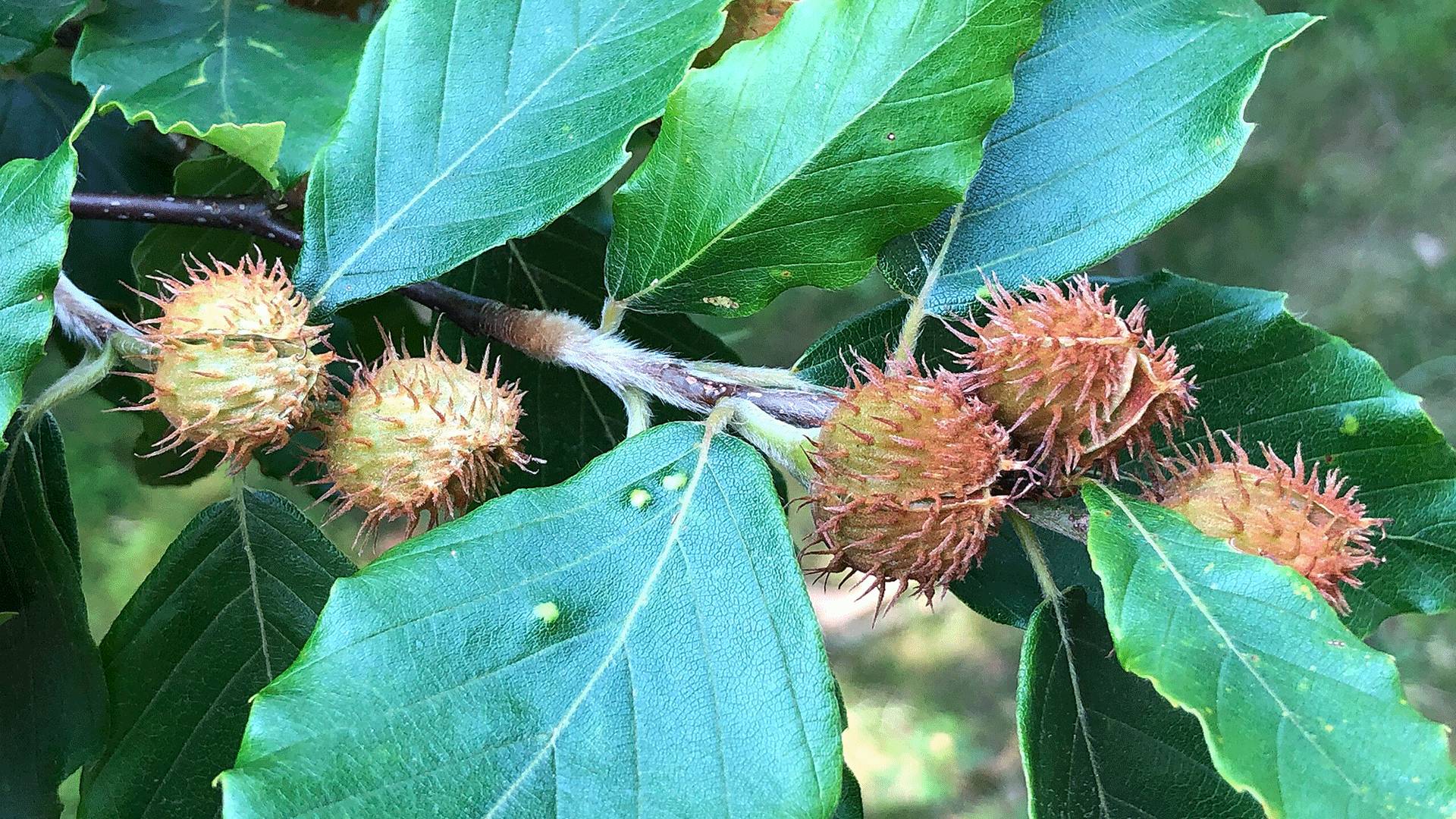
Beech seeds are small, triangular nuts that grow in prickly husks (see above) and are crucially important as a food source for wild animals, from Eastern Grey Squirrels to Wild Turkeys and Black Bears.
While usually a component of mixed forests, pure beech stands are sometimes found on hillsides and ridges in rich, well-drained soils, or in lowland areas where heavy browsing by sheep or Whitetail Deer has excluded other deciduous species.
When healthy, American Beech can reach 115 feet tall, but more commonly 50-70 feet. In New England, beech trees typically reach 2-3 feet in diameter, but larger specimens are sometimes observed in open-grown conditions such as parks. Healthy beech trees can reach 300-400 years of age.

American Beech, Brian Milakovsky
The tree has beautiful, smooth grey bark and gun-barrel straight trunks. Its leaves are 4 inches long and toothed with a pointed tip, and turn primarily yellow in the fall.

Healthy American Beech bark, Katja Schulz | Creative Commons CC BY 2.0

American Beech leaves in October, Katja Schulz | Creative Commons CC BY 2.0
As late as the 1920s, American Beech was a valuable wood species in New England that was used for furniture, cabinetry, wooden utensils and toys. Its cousin, European Beech (Fagus sylvatica), is still one of Europe’s premier furniture species.
While its value had already been somewhat in decline, American Beech became relegated to low-value uses like firewood or pulpwood in New England after the introduction of the beech bark disease in the early 1900s. This insect-fungus complex was believed to have been introduced to North America on decorative European beech trees imported to Halifax, Nova Scotia.
The invasive Beech Scale insect feeds on tree fluids and creates cracks that allow a native canker fungus to enter a tree’s bark. This results in the formation of ugly cankers over most of the trunk, which with time disrupt the normal functioning of the “living bark” (cambium), causing decline and death. A very small percentage of American Beech are entirely resistant to beech bark disease, while others show resistance: cankers are present but the tree remains vigorous. The vast majority of trees are highly susceptible, and so will never grow to be full-sized trees with valuable wood.
Despite spoiling the beauty and commercial value of American Beech, the beech bark disease did not lead to the species dying out in New England. On the contrary, beech sprouts vigorously from the roots when its trunk is either cut or dies from the disease. Beech became much less common as an overstory tree, but perhaps more common in the middle and lower layers of mixed forests, where it forms dense thickets.
From the point of view of wildlife biologists and hunters, it is a relief that beech remains in the forest as a critical food source for wildlife. But foresters have long been frustrated by beech’s tendency to sprout vigorously after timber harvests, filling the growing space they would like to devote to new generations of tree species like oak, pine or spruce, which still have commercial value.
The severity of beech bark disease has varied across New England. Residents of some parts of Connecticut or Massachusetts may have encountered beech almost in its natural state, with only limited signs of disease. Especially as you move north and east, however, the severity becomes far worse. In much of Maine, beech is extremely common but usually in a sorry state, except for a very few majestic specimens of resistant “smooth beech” scattered across the landscape. These often show the claw marks of Black Bears, who climb the smooth trunks to strip beech nuts from the branches in the elevated crown.
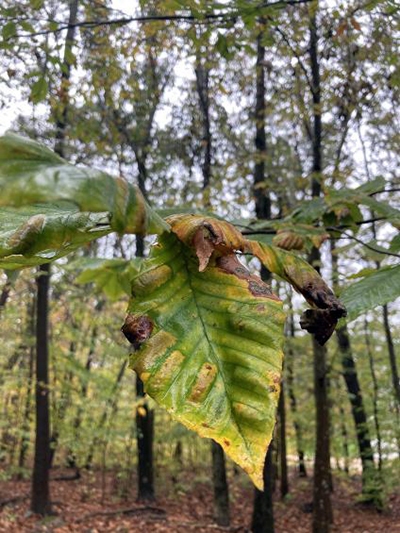
Beach leaf disease in action, USDA Forest Service photo by Cameron McIntire.
But even this picture is now changing, and not for the better. A new exotic pest — a nematode — has entered New England, and it causes beech leaf disease. This pest spreads much faster than beech bark disease and in just a few years has infected most of New England’s beech forests. The nematodes burrow into beech leaves and buds, causing the leaves to turn lumpy and crinkly, disrupting their photosynthetic activity. The visual effect is quite stunning, with the dense green wall of beech foliage thinning out, allowing you to see much farther than usual in many New England forests.
Scientists are racing to understand this disease and how it might be countered. They are starting to observe serious mortality in some locations, suggesting that beech leaf disease may be far more devastating to American Beech than the bark disease. Several treatments of individual trees appear effective at holding off the worst symptoms, such as injecting them with certain herbicides or applying polyphosphite fertilizer to the roots. This is being implemented on an experimental basis, but scientists are looking for ways to make these treatments less expensive and more scalable. They are also experimenting with whether a crown thinning (removal of competing trees around the crown of a desired crop tree) can help reduce leaf damage from the nematodes, which seem to spread best in dark, damp conditions.
American Beech is one of the signature trees of New England, but its troubled fate reminds us that for all the resilience of our region’s forests, they are not indestructible. There is still far more for us to do to prevent new pests and pathogens from attacking our forests, and — through good science and management — to support the recovery of those tree species already affected.