Star Singer of the Northern Forest: The Wood Thrush
Jun. 18, 2026
Learn about wood thrush natural history and conservation, and how a NEFF…
Read More


Many of our beloved and bright-hued birds have migrated south for the winter, but that doesn’t mean New England is bereft of bird-related charms. The region’s owls spend the winter with us, and there’s really nothing more magical than hearing the hoo-h’HOO-hoo-hoo of a great horned owl calling through the forest on a cold, clear night.
NEFF has prepared a roundup of New England’s forestland owl species, which have been divided into Common and Uncommon Species. Common Species live year-round in at least part of New England and are seen regularly; Uncommon Species live only part of the year in the region or they’re genuinely hard to spot.
Wintertime adaptations won’t be the main focus of this blog post, but each of these owls is well equipped to survive New England winters. For example, their asymmetrical ear openings help them hunt by sound alone, even if their prey is scurrying around under a thick layer of crusted snow, and the owls’ sharp talons help them then get through that snow. They also have feathered legs and feet to help them stay warm, unlike many other birds.
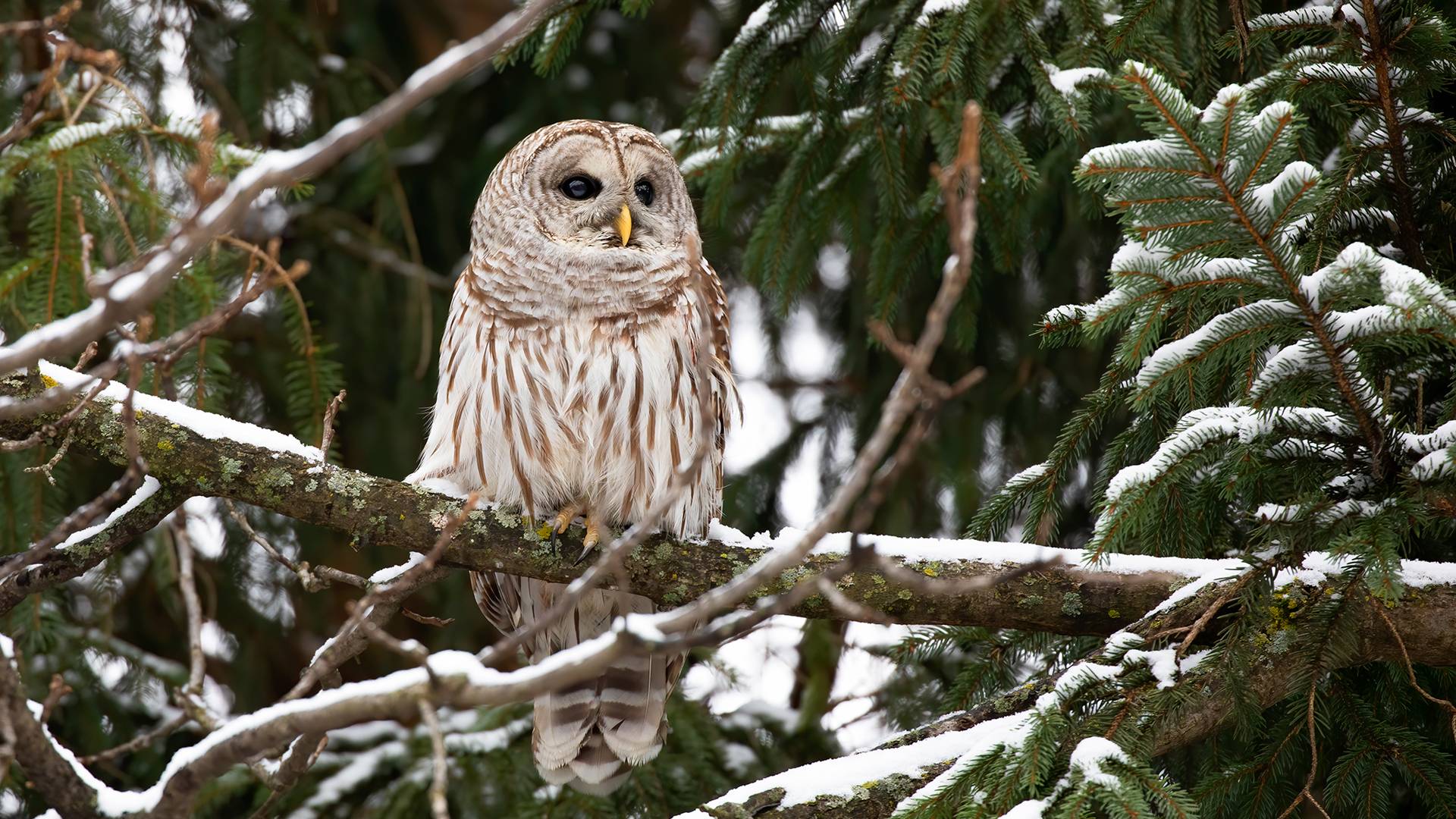
This year-round New England resident is known for its Who cooks for you? call. Barred owls live in large, mature forests and roost during the day, but can still sometimes be heard calling in daylight hours. They prefer forests with large trees near water. Why water? One possible reason is that while barred owls eat all kinds of small prey, they sometimes perch over water and just… drop in to catch fish, or wade into shallow water for fish and crayfish.
Barred owls roost on branches and in tree cavities, and nest in tree cavities 20-40 feet above the ground in large trees. They sometimes scout out nesting sites a year in advance, are highly territorial, and chase away and hoot at intruders. They escalate to attacking intruders — including humans — with their feet during nesting season.
“Barred Owls are easiest to find when they are active at night — they’re a lot easier to hear than to see. Visit forests near water (big bottomland forest along a river is prime barred owl habitat) and listen carefully, paying attention for the species’ barking ‘Who cooks for you?’ call. … During the daytime, a quiet walk through mature forest might reveal a roosting barred owl if you are lucky.”

Eastern screech-owl
We’ve got a tree hugger on our hands. Cornell Lab of Ornithology’s All About Birds website says “trees define” the eastern screech-owl’s habitat, and that it “shuns treeless expanses of mountains or plains.” For all that, screech-owls aren’t picky about what type of trees they live in, and can even be found living and breeding in suburbs and urban parks.
Eastern screech-owls nest in tree holes and cavities, but won’t dig one themselves, and so turn to holes created by other wild animals or natural processes — think, fungus. They’ll also gladly accept nest boxes.
“Listen in wooded areas at night for the trills and whinnies of this vocal owl. Your best chance… may be to listen for the excited voices of songbirds mobbing an owl they have found. You can also look closely at tree cavities and nest boxes; especially on cold sunny days, you may see the owl sunning sleepily in the entrance.”

Great horned owl
Great horned owls are the humans of the owl world when it comes to adaptability, and can be found across the continent living in a range of forest types, from orchards to old-growth stands, as well as in swamps, agricultural areas, wetlands, deserts, parks, suburbs, and cities. Most often, they use some type of forestland and open habitat at the same time. When it comes to nesting, they usually take over another species’ abandoned nest, but will also use cavities in live trees and dead snags… and deserted buildings, cliff ledges, and human-made platforms, in keeping with the adaptability theme.
Winter isn’t slowing great horned owls down any: among northern birds, they tend to nest unusually early, and Maine Audubon believes they’re Maine’s earliest nesting bird. This is why we can hear the hoo-h’HOO-hoo-hoo of a great horned owl calling in winter months: that’s one mate calling to another as they begin nesting.
“You may see them at dusk sitting on fence posts or tree limbs at the edges of open areas, or flying across roads or fields with stiff, deep beats of their rounded wings.”

Long-eared owl
We’ve listed long-eared owls as an “Uncommon Species” because most of them only migrate through New England, with some wintering in part of southern New England, and more’s the pity, because those ears are pretty cute.
They spend their days roosting in dense vegetation — preferably near tree trunks, where their plumage and the dim lighting can camouflage them best — and aren’t exacting about locations for nighttime foraging, which they’ll conduct in open grasslands, shrublands, marshes, and open coniferous or deciduous woodlands. They’re also chatty, and the All About Birds website states they make “an incredible variety of hoots, squeals, barks, and other noises.” In a remarkable deviation from the other owls on this list, up to 100 long-eared owls will roost together in winter.
Long-eared owls eat mostly small mammals, including voles, mice, and young rats or rabbits, but they also sometimes take on larger prey like small birds, and rarely, moles, bats, weasels, chipmunks, ground and tree squirrels, snakes, and lizards.
“In winter, methodically search pine stands or shelterbelts near grassland or pasture for roosting owls, often close to the tree trunk among dense branches. Also look along the ground for pellets (gray, roughly oval cylinders of regurgitated fur, feathers, and bone). If you find a large number of these, you may be under a roost tree. Long-eared Owl pellets are typically 2-3” long… Also scan the ground and lower branches for extensive whitewash (bird droppings), which can also indicate recent roosting by owls.”

Northern saw-whet owl
This is a hard owl not to love, between its small size, round face disk, and white head speckles, which make it look like it’s just been dusted in snow.
Northern saw-whet owls make a high-pitched, nighttime too-too-too call from January through May, and this is birders’ best bet for at least identifying the general location of these hard-to-spot owls. They eat small mammals, most often deer mice and white-footed mice, and hunt them strictly at night from the forest edge.
Northern saw-whets live out their full life cycle here. The All About Birds website says they seem to prefer dense conifers for daytime roosting and deciduous trees for nesting, where they seek out holes in dead snags, usually those left behind by woodpeckers. Once winter arrives, saw-whets prefer the shelter of dense forest.
We already addressed what to do at night. During the day, head to dense conifers and then “pay attention to small songbirds — if they discover a roosting saw-whet, they’re likely to kick up a racket, calling and flying at the owl until it moves on.”
You may have noticed a through-line in this blog post — while these owls are of course generally dependent on forests, those who spend their entire life in New England also have particular nesting needs: holes and cavities in a living tree or snag, though the great horned owl remains flexible.
NEFF’s Exemplary Forestry standards are designed to improve biodiversity and wildlife habitat for a broad range of species, and so Exemplary Forestry harvests leave snags and trees with nesting cavities intact. Exemplary Forestry harvests also leave legacy trees intact whenever possible, which means that over time, the impacted forest will retain more large trees — and their eventual nesting cavities — and snags. A legacy tree is a tree of critical value left standing during a timber harvest to grow forever, and their value can include serving as an ideal seed source, contributing to tree species biodiversity, providing wildlife habitat, and supporting general biodiversity in managed forests. Over time, they almost all turn into snags.
Ensuring healthy owl populations keep sharing their winters with us for decades to come is just another reason to support NEFF’s work to expand the implementation of Exemplary Forestry.
Field Guide to the Birds of Eastern North America, National Geographic
The Sibley Guide to Birds
All About Birds: Barred Owl
All About Birds: Eastern Screech-Owl
All About Birds: Great Horned Owl
Maine Audubon: Backyard Bird of the Month
All About Birds: Long-eared Owl
All About Birds: Northern Saw-whet Owl