The Whole Forest: A Unified Path for New England’s Landscapes
May. 19, 2026
A guest blog from Yale School of the Environment students
Read More


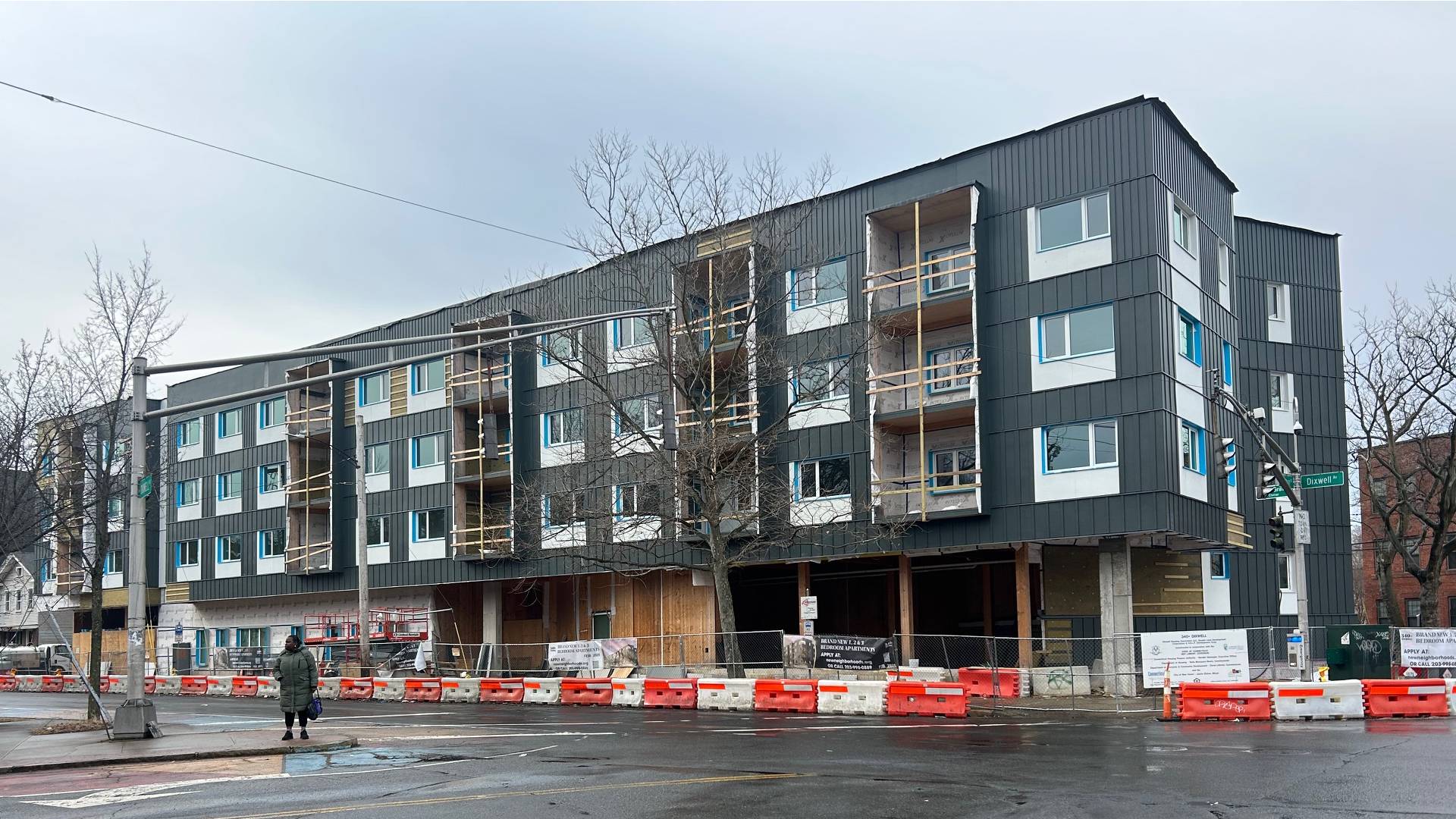
The housing affordability crisis is one of the top issues of concern for Americans today—one we regularly see highlighted in the news and feel within our communities. New England Forestry Foundation (NEFF) and others have been working to introduce a new tool to this challenge: mass timber—a class of engineered wood building products made by combining multiple layers of wood into panels and beams that are significantly stronger than traditional timber. As a construction material, mass timber has a number of unique properties that make it well suited to affordably addressing limited housing supply. Let’s take a look at the state of the housing crisis to understand what issues NEFF and its partners are tackling, and then learn how mass timber can help.
A recent assessment of affordable housing need was carried out by Jeff Spiritos of Spiritos Properties as part of the market development work conducted under NEFF’s USDA-funded Climate-Smart Commodities (CSC) Project (which includes building the market for climate-smart forest products, with a focus on mass timber construction). That effort found there are only 35 rental homes available for every 100 renters in the Northeast, with a shortfall of around 1.5 million households. And the shortfall is a striking 7.5 million households nationally. Meanwhile, the number of “cost burdened” households (homeowners and renters)—those paying more than 30 percent of their gross income for all housing costs—has been on the rise for more than 20 years in the U.S.
Insufficient housing supply and rising costs are central to this issue, although the factors driving the severity of the problem in specific regions can be complex. The housing shortfall not only affects extremely and very low-income households (defined as at or below 50% AMI), but high construction costs and interest rates have restricted housing supply of all types, from single family and townhomes to large, mixed-income or market rate multifamily apartment buildings.
This overview shows us that, at the highest level, the big questions for addressing the housing crisis are: How do we build more housing, more quickly, where it is most needed? And how do we do that while leveling or reducing costs?
Addressing the supply challenge will require changes to local zoning and urban planning that make it possible to build more in key areas. But a related solution lies in the materials and construction systems we use—innovative wood products and construction techniques have the potential to decrease cost and increase the speed of construction. This can bring more affordable units of housing onto the market in the near term. And this is why the market development work under NEFF’s CSC project has such a strong focus on accelerating the use of mass timber construction for housing in the Northeast—there is a potential triple win here for rural forest-based economies, urban and suburban communities, and state environmental goals.
Mass timber can reduce the “hard costs” (which account for 50-70% of all construction costs) for multi-family projects. This is due to several characteristics associated with mass timber, including the need for less on-site labor, the ability to leave some structural surfaces exposed and use fewer finishes, smaller foundation requirements, and the ability to use off-site construction and prefabricated components. Time is money, and the speed of mass timber construction is also a significant cost saver. Mass timber buildings can be erected in a fraction of the time compared to similar structures made of concrete and steel because mass timber panels and beams can be prefabricated away from the construction site to exact specifications and then brought to the site ready to be put together quickly with much less on-site labor.
Most single-family homes and low-rise apartment buildings in the U.S. are already built with wood using light frame construction, but a larger proportion of multi-family residences are built with concrete and steel. There is an exciting opportunity to bring significant innovation to the multi-family arena with mass timber, which is suitable for the same building types where concrete and steel currently dominate because it has the fire-resistance and strength to be used as an alternative to concrete and steel in buildings up to 18-stories (under the 2021 International Building Code).
Mass timber’s potential is well-captured in this quote, pulled from the Executive Summary of another soon-to-be-published report created under the auspices of NEFF’s CSC market development work, by award-winning architect Tom Chung:
“For the building sector, a solution resides in the use of a renewable building material – wood. It is one of humankind’s oldest building materials, yet through digital fabrication technology it has been transformed into a cutting edge, precise, low waste and low carbon footprint building material that can build much of the largest, tallest and complex buildings our society needs, while making these spaces feel better, reducing stress and increasing general human wellness.”
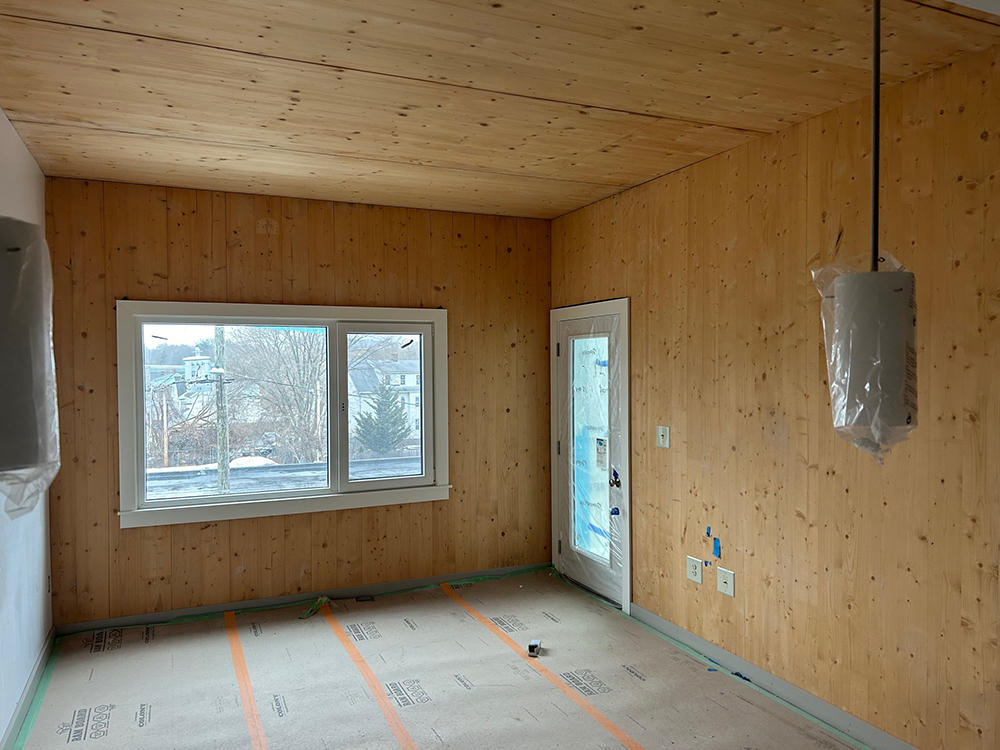
340+ Dixwell Ave mass timber project, New Haven, CT
This is good news for places that need more multi-family residences in the mix of their housing stock, including the biggest urban centers in southern New England. The Metropolitan Area Planning Council, which is the regional planning agency for the 101 cities and towns of the Boston metro area, projects that “nearly two-thirds of housing demand moving forward will be for multifamily units (apartments or condominiums).”* Mass timber is well-suited to meet that demand in Boston and elsewhere because of the cost-saving factors described above.
Over the years, as I’ve presented to a variety of audiences on the linkages between affordable housing and mass timber, I’ve developed a one-slide summary of the opportunity—below:
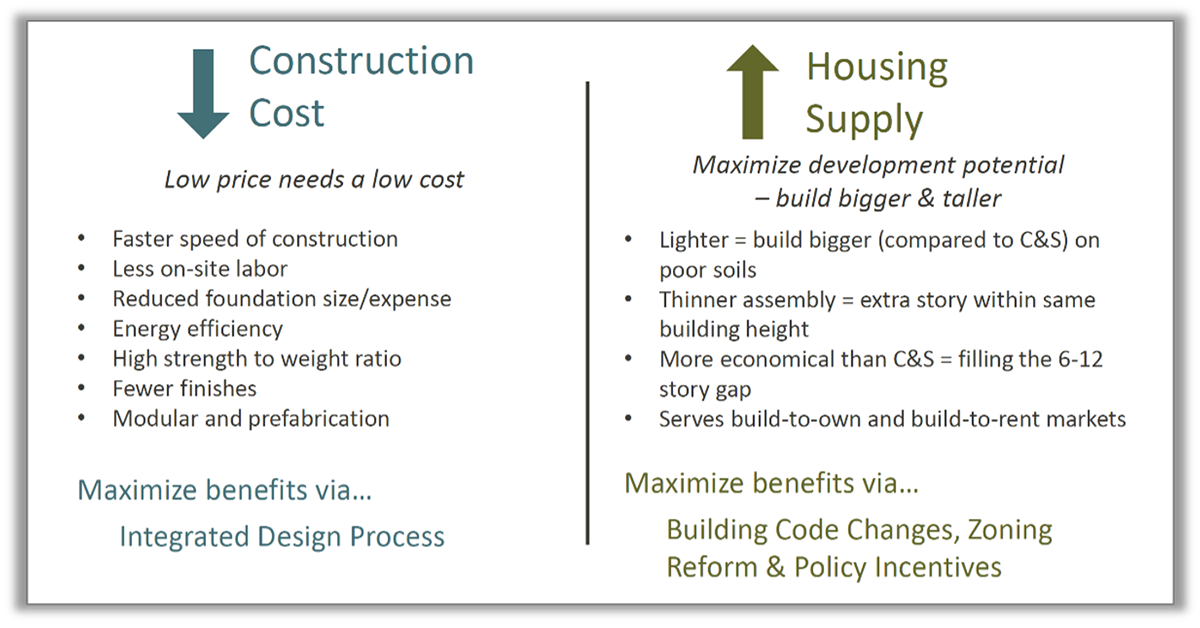
Many of the benefits noted in that slide (and others) are extoled in more detail in another report from NEFF’s CSC project entitled “Mass Timber in Affordable Multi-Family: A Blueprint for design.” The report describes three of the most common mass timber structural systems used in multi-family projects, with example buildings and design considerations for each. As noted in the introduction of the report, “For mass timber to be cost competitive in this multi-family subsegment, design efficiency, material optimization, and a wholistic understanding of where savings may lie are especially important.” Architects, engineers, developers, and others looking to use mass timber for this building typology are encouraged to heed that advice and read the report, which contains a wealth of information about meeting building code requirements for fire resistance, acoustics, etc. and other topics.
Together we can push for scalable housing solutions that deliver beautiful, quality, and sustainable living spaces for people all along the economic spectrum.
*Quote is from page five of The State of Zoning for Multi-Family Housing In Greater Boston