The Whole Forest: A Unified Path for New England’s Landscapes
May. 19, 2026
A guest blog from Yale School of the Environment students
Read More


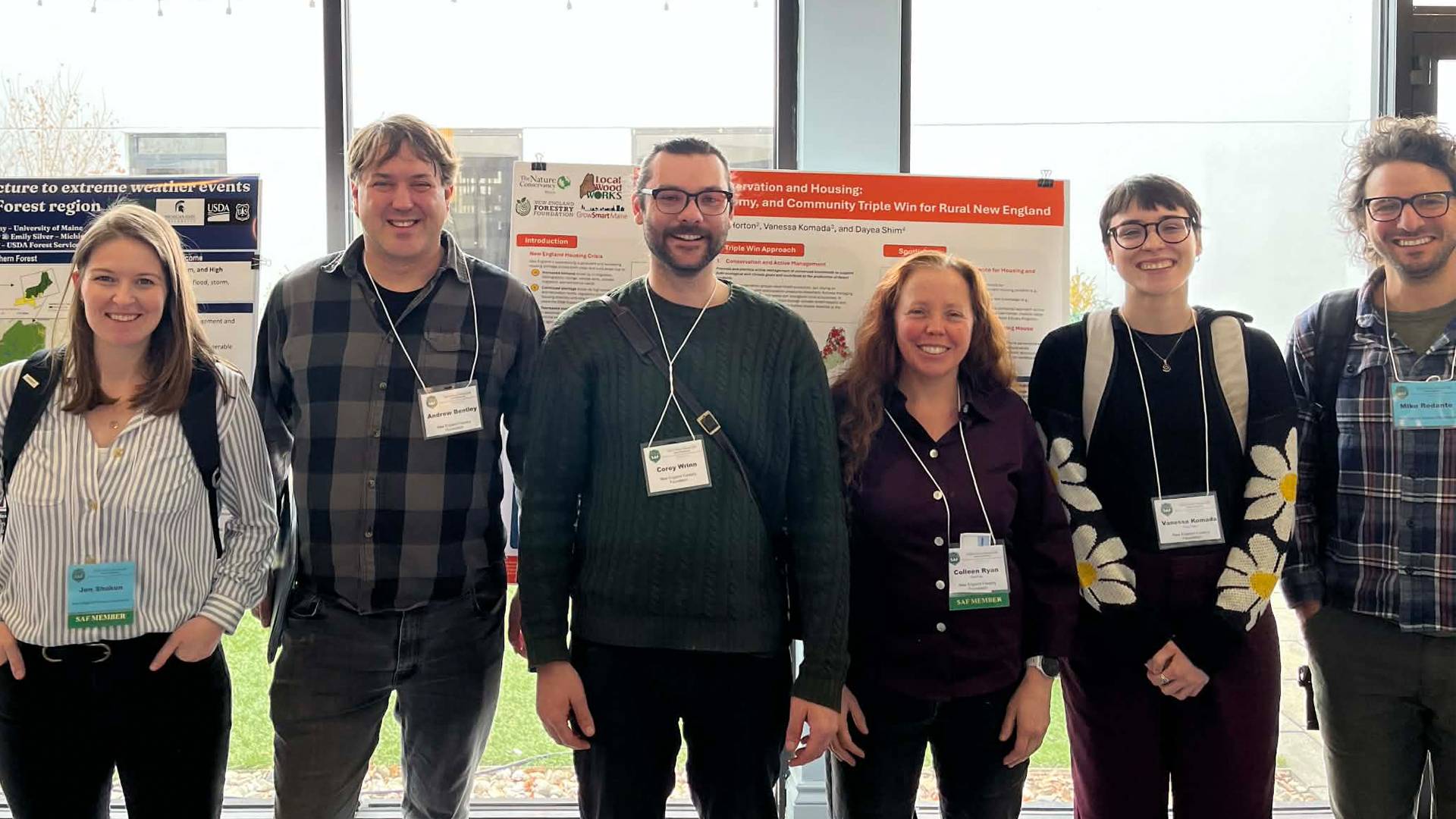
Hosted in Portland, Maine, the Winter Conference of the New England Society of American Foresters (NESAF) brought together a range of perspectives on the challenges facing the region’s forests. Across sessions, a common question emerged: how do we sustain forests in a system that undervalues them?
In the opening plenary, Maine State Forester Patty Cormier noted that forest cover in Maine has declined from 90 to 88 percent over the past decade — an incremental but important shift. A panel on local markets further highlighted that New England’s $29.7 billion forest economy is under pressure, particularly with the long-term loss of pulp and paper markets. At the same time, as Steve Tatko of the Appalachian Mountain Club emphasized, public investment remains uneven, with U.S. oil and gas receiving more than $20 billion annually in subsidies compared to less than $1 billion for forestry.
Together, these discussions underscored a central tension: forests provide significant public benefits, yet they are largely undervalued or treated as private commodities. This is especially evident in cases like the Sebago watershed that supplies Portland’s drinking water. Of the 13,000 water suppliers in the country, Portland is one of only 50 that is exempt from filtering their water before treating it due to the array of private forestlands throughout the watershed that naturally provide that filtering, thereby helping to avoid roughly $400 million in water filtration costs — and yet landowners in the watershed receive limited or no direct compensation for this service.
While the conference covered a wide range of topics, the overarching theme was clear — sustaining forests will require not just technical solutions, but a broader shift in how we value and invest in the services they provide.
Encouragingly, several research projects and partnerships are already working incrementally toward solutions. A few are highlighted below.
MIT’s Odds and Mods group is currently developing technologies to help utilize low-value wood (such as branches and small logs leftover from logging and mill waste) in building design. The team has recently created a phone app that can fully scan odd-shaped pieces of wood and whole trees to evaluate its structural performance and properties. This work reflects a shift from valuing forests based on uniform, high-grade products to valuing the full resource — including what was previously considered waste.
There were several talks about forest resilience, including from Dr. Mindy Crandall with Oregon State University, Wildlife Biologist Sarah Spencer with Maine Parks and Lands, and Amanda Farris with The Nature Conservancy. These talks all point to a broader shift: moving from valuing forests for single outputs (like timber) to valuing them as diverse, resilient systems.
Dr. Crandall highlights that market uncertainty makes tree species diversity an economic strategy, while Spencer shows it’s essential for habitat resilience. Farris ties this together, emphasizing diversity, complexity, and continuity as core principles. If resilience is the goal, then diversity is the value — and that’s what we need to invest in.
This represents a shift from optimizing forests for short-term efficiency to investing in long-term adaptability, where ecological health, economic flexibility, and ecosystem services — like habitat and climate regulation — are all part of the same value system.
Hunter Moore with the University of New Hampshire conducted research on using LiDAR (Light Detection and Ranging) to map out the structural properties of complex, mixed species forests in New England. LiDAR is a remote sensing technology that uses laser pulses to measure distances and create precise, 3D representations of objects and environments, such as trees.
Tools like LiDAR make it possible to capture the complexity of mixed-species forests — their structure, diversity, and condition — in far greater detail than traditional methods. While the technology isn’t perfect yet, it moves us toward a more accurate, data-driven understanding of forest health and function. That matters because you can’t invest in what you can’t measure. His research indicated an 85 percent rate of accurate tree detection, 14.7 percent tree omission rate, and a 23.5 percent rate of “false” tree creation. By improving how we quantify forest structure and condition, technologies like LiDAR help support better management decisions and more targeted harvesting.
Until next time,
Vanessa