NEFF’s Summer iNaturalist Highlights and Citizen Science
Oct. 30, 2025
NEFF's summer iNaturalist highlights and how we're tracking beech leaf disease…
Read More


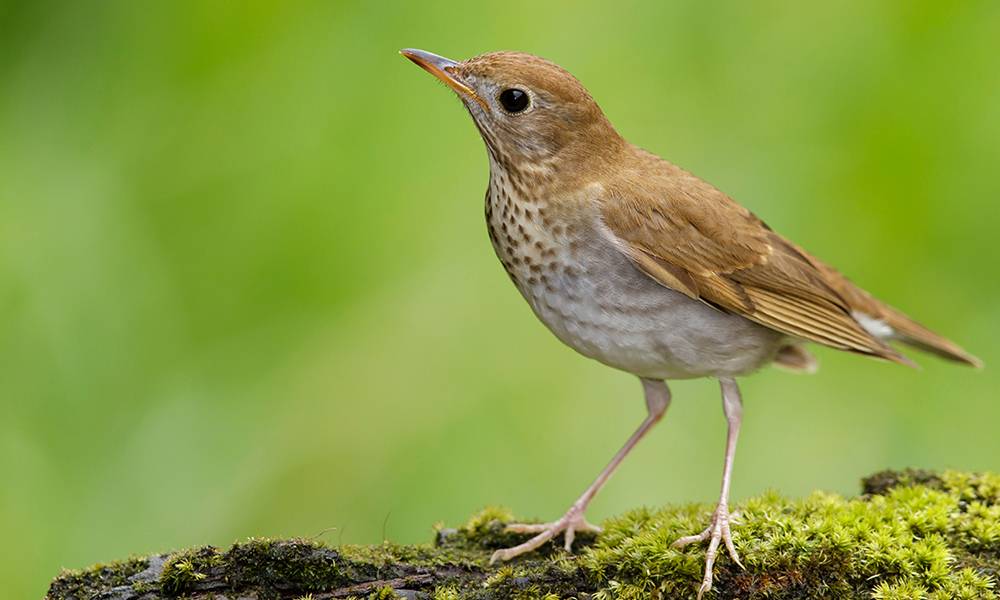
“At evening the Veery’s note rose and fell among the firs, as if the wood itself were breathing. Near such a song one feels as if he had entered some ancient temple of God, where the worship has been carried on with silent reverence from age to age. I remember sitting for hours under a cedar, listening to the clear, soft, descending whistle of a thrush that seemed to come from an invisible choir within the forest.”
— 1864 Houghton, Mifflin & Co. edition of Henry D. Thoreau’s The Maine Woods
The descending song of the veery spiraling down through the shaded understory of the northern forest conjures magic, as if two pan pipes were being played in harmony near woodland pools deep in the forest.
For hikers in the northern woods who birdwatch on the fly but are not experts, it simplifies bird identification to think of the veery as part of a group of brown forest thrushes that come in plain brown wrappers. The veery, hermit thrush, wood thrush, Swainson’s thrush, and Bicknell’s thrush are more or less the size and shape of a robin, to which they are related, and all have variations of the same look: a white belly, large dark spots on the chest or belly, and a brownish back.
They may visit a bird bath or even yards as they move from South America and the Caribbean to the northern forests during migration, but they are birds of the interior forest. Once there, they keep a low profile.
Except when they sing.
Their songs are where the brown thrushes shine. Their resonant songs, each specific to the species, seem to give voice to the forest itself as if the songs are everywhere at once, near and far, intimate and transcendent.
The biological facts don’t wash the woodland magic away.
The songs of the thrushes may captivate us, but bird song is a language that serves two important biological functions: it’s a love song to lure a mate and a fight song to warn other males of the same species to back off — the veery is singing that this particular plot of dense forest understory near a stream is taken for the nesting season.
The flutey notes and fluttering trills of the brown thrushes are the result of each bird singing two separate songs at the same time. The thrushes have a double voice box, called a syrinx, which allows each bird to harmonize with itself.
Like their distinct songs, each of the brown group of thrushes that breed in the northern New England forest is distinct, with separate habitat requirements for feeding, hiding, breeding, and successfully raising young.
The hermit thrush, the most common, has a reddish-brown tail that it often flicks up and down when perched a foot or so from the forest floor where it likes to hunt for insects. It tends to be the most commonly seen when hiking in the woods and is the most commonly heard, often late into the summer night. In hardwood stands, its haunting song bounces off the tree trunks and carries far. The female sits the nest on the forest floor for about two weeks before the turquoise blue eggs hatch. The young fledge about two weeks later. This morning, deep in my Maine woods, I saw a female sitting the nest beneath a bracken fern. I was three feet away, and she was almost indistinguishable from the leaf litter. Her eyes got wider but she didn’t even blink.
The Swainson’s thrush, an olive brown bird with a white belly and chest covered in dark spots, has a song that rises up in an ascending spiral. It breeds in the spruce and fir forest and is found in the mid-to high elevations.
The Bicknell’s thrush, which is similar in looks to the gray-cheeked thrush that heads to the Arctic, was long thought to be the same species. Skeptics dispute whether it is a distinct species. Its song starts like the gray-cheeked, too, but finishes in a distinctive trill. Bicknell’s has extremely specialized habitat at high elevations where fir grows stunted into krummholz from bitter cold and high winds in winter, though Bicknell’s thrush will take advantage of messy habitat of blowdowns and rockslides in spruce and fir, and I have heard one there and confirmed it with a siting, though I am no expert. Bicknell’s winter in the Caribbean: research indicates that over 50 percent of the global population winters in the cloud forests of the Dominican Republic. Some also winter in Cuba.
When the veery sings, it sounds as liquid as the watery woods it favors.
Depending on how much food is available nearby, the veery territory ranges from a quarter acre to 7.5 acres within a larger forest block.
Veerys are more adaptable than some thrushes, preferring a middle-aged forest, known as an intermediate forest, with trees 20-70 years old with tree sizes varying from the width of a dessert plate to that of a dinner plate – or about 5 inches to 10 inches in diameter at breast height. But the veery will also use an older or younger forest. This flexibility allows this species to adapt to changing forest conditions more readily than a wood thrush, whose population declines are related to the loss of larger blocks of undeveloped forest, the Bicknell’s thrush, whose nesting habitat is very specific to rocky mountaintops with scrubby fir trees, or the rapidly declining Canada warbler, which is tied to very specific forest habitat conditions and is a poster child for habitat loss in the northeast.
NEFF’s Western Maine Habitat project includes practices that favor all these habitats on properties where that is possible, or offset the loss of some of these habitat needs across a larger area.
NEFF’s Exemplary Forestry for the Acadian Forest includes balanced forest management guidelines that take the long view to increase forest structure that, over time, is designed to create more native bird, fish, and wildlife habitat while providing climate values and growing more and higher quality wood to harvest. NEFF’s Exemplary Forestry is also one aspect of NEFF’s 30 Percent Solution to climate change.