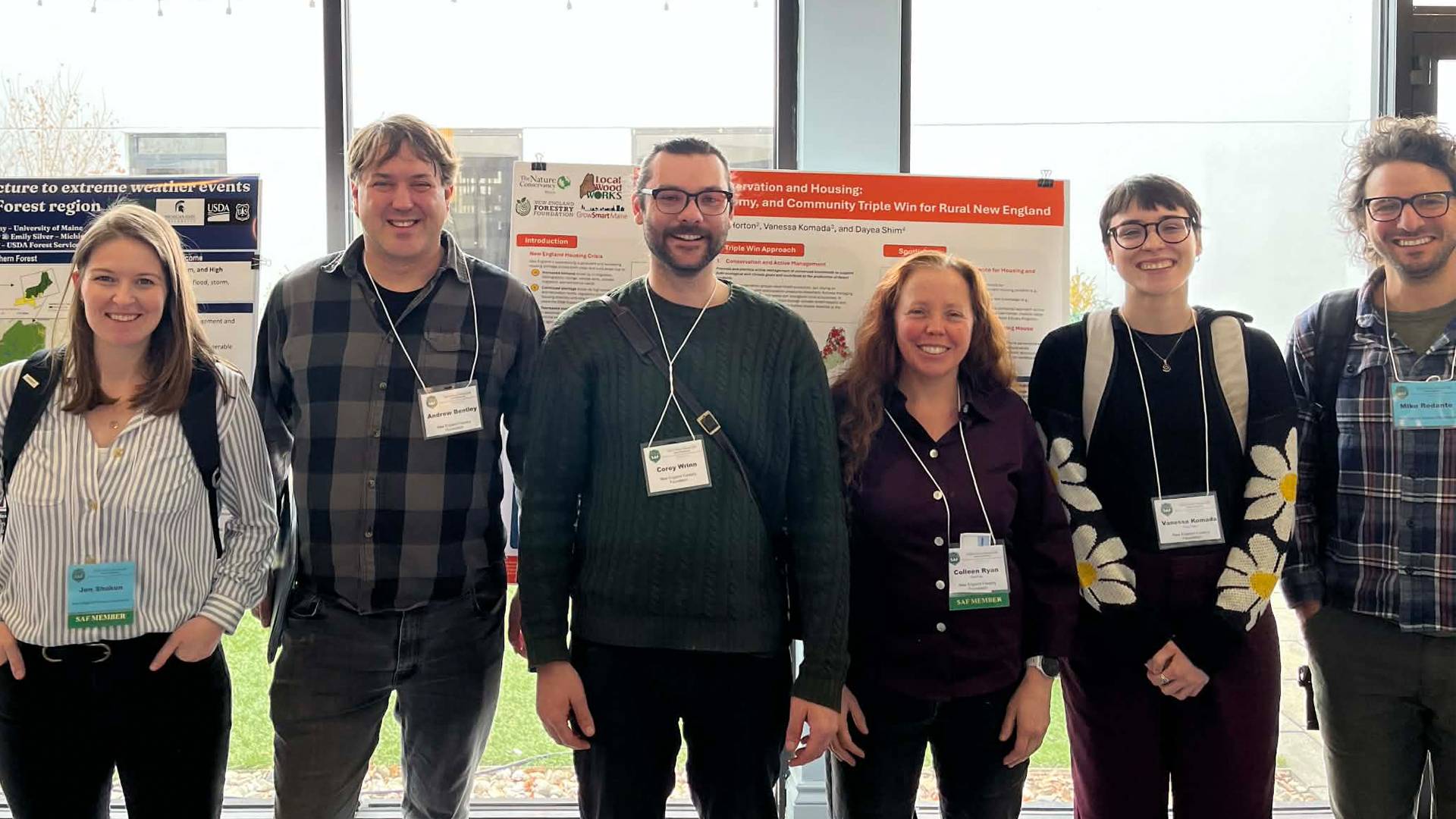
NEFF’s Vanessa Komada Identifies Profound Theme at NESAF Conference
May. 04, 2026
How do we sustain forests in a system that undervalues them?
Read More


New England Forestry Foundation (NEFF) has been thinking deeply about the intersection of forest management, sustainability, and climate for more than a decade, and has now published its second peer-reviewed article on the topic, “Redefining sustainable forestry for a climate emergency” in Forest Ecology and Management. The paper was coauthored by R. Alec Giffen, Colleen M. Ryan, Frank Lowenstein, Robert T. Perschel, and Mary L. Tyrrell, four of whom you may recognize from NEFF’s staff, past and present.
As humanity faces a climate emergency with effectively only 30 years to influence the trajectory of climate change, NEFF feels it’s no longer possible to practice “sustainable” forest management unless that forestry accounts for forests’ ability to mitigate climate change and their need to adapt to it. Yet, no current and widely accepted approach to sustainable forestry prioritizes mitigating climate change.
The concept of sustainability forestry — which has existed since at least the 18th century — has evolved as circumstances and our understanding of forests and science changed over time. In this moment of climate crisis, NEFF has decided to be proactive, and proposed the following definition of sustainable forestry for the 21st century in our new paper:
“Sustainable forestry is forest management that prioritizes mitigating and adapting to climate change during the next several decades as a critical aspect of meeting the social, economic, ecological, and spiritual needs of current and future generations.”
The paper goes on to list proposed “essential elements… for forestry on actively managed lands to meet this definition of sustainability.” These elements include both existing aspects of sustainable forestry, such as managing forests for erosion control, water quality, biodiversity, and wildlife habitat, as well as actions that specifically address climate mitigation and adaptation, like “optimizing carbon storage at the landscape scale while maintaining or increasing harvest levels to avoid leakage.” The forest as a whole is valued under this new definition, alongside the progress we can make against climate change.
Furthermore, the paper states, “Our proposed definition of sustainable forestry presupposes that sustainable forestry on actively managed lands will be complemented by a system of strategically located, passively managed ecological reserves. Maintaining such a system is essential for any approach to forestry to be truly sustainable for multiple values.”
So, this new definition doesn’t toss aside water quality, biodiversity, and wildlife habitat for climate mitigation within managed forestlands, and beyond managed forests, calls for a network of ecological reserves. We have a truly balanced approach on our hands.
When it comes to implementing the new definition, NEFF advocates for taking a landscape-scale and systems-based approach. This means that the best approach for the climate and the forest considers carbon storage but doesn’t necessarily maximize carbon storage in every individual tree or forest stand across said landscape. Instead, those at work on these issues need to determine the best role for stands in the managed area, and analyze the larger social and economic systems that impact forests and climate, with the goal of: storing as much carbon as possible in healthy and resilient forests, and also in long-lived forest products (with their long-term ability to store carbon) that substitute for fossil-fuel-based materials. While at the same time, foresters ensure forests are well adapted to future conditions, and resilient to new threats and disturbances so the carbon they store is as durable as possible.
Ultimately, this paper provides a call to action for the forest community as a whole. NEFF has already made great contributions to this effort by developing and releasing our Exemplary Forestry standards, and advancing our 30 Percent Solution and the Forest Carbon for Commercial Landowners initiative. We hope that other organizations, landowners, and foresters will embrace this new definition and approach, which is urgently needed to ensure that forests meet their potential in addressing climate change while also continuing to provide all the other benefits they bring to the world.