The Science and Beauty of Flowering Trees
May. 18, 2026
The trees within our forests are in full bloom, and color is now dotting the…
Read More


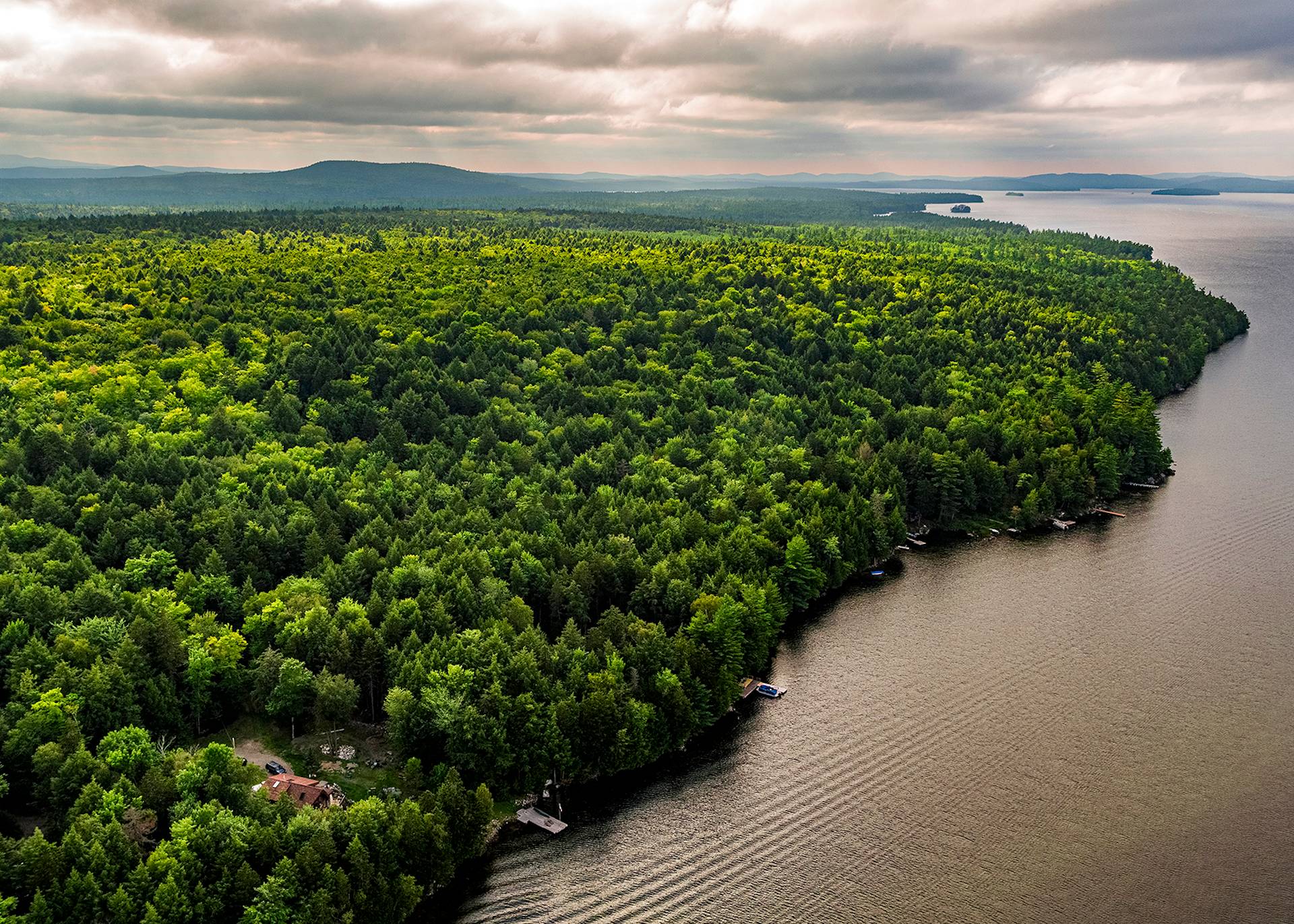
As long-term readers know, New England Forestry Foundation (NEFF) has created a custom, three-level monitoring system complete with aerial photography missions that allows NEFF to steward our largest conservation easements: the 762,000-acre Pingree easement and the 335,000-acre Downeast Lakes Forestry Partnership easements. NEFF does so to make sure the properties’ natural resources are protected.
NEFF Conservation Easement Director Andrew Bentley conducted the final stage of monitoring on the Downeast Lakes Forestry Partnership easements in October 2025 and shares his experiences below; this monitoring level features NEFF staff spending several days driving long distances and then bushwhacking in to inspect priority sites. Read about the entire process: Stewarding a Landscape.
Writing by NEFF Conservation Easement Director Andrew Bentley
Each year, as the days grow shorter and flannel weather arrives, I gear up for my annual trip to inspect NEFF’s large easements in interior Washington County, Maine. The University of Maine’s Dave Sandilands has already sent updated 2025 photos taken with an aerial infrared camera optimized to enhance the differences between vegetation and manmade objects, which are vital to prioritizing where I visit on the ground. Otherwise, how would anyone know where to start looking on 335,000 acres? Our contractor Ned Telling of New England Forestry Consultants has also received his photos for and completed his inspection of the Pingree easement’s 762,000 acres.
I leave home well before dawn to meet staff of Downeast Lakes Land Trust (DLLT) in Grand Lake Stream, and to inspect the 23,000+ acre* easements on part of their vast, 58,000+ acre Community Forest. I arrive, and, as usual, expert forester Ernest Carle is ready to roll. We also have new company — Brian Tripp, DLLT’s Executive Director as of June 2025.
*A note about the Downeast Lakes Forestry Partnership’s easement acres: they are split between NEFF’s 312,000-acre Sunrise Tree Farm easement — where approximately 287,000 belong to Typhoon LLC, represented by Wagner Forest Management, and 24,000 belong to The Baskahegan Company — and NEFF’s easements with Downeast Lakes Land Trust.
Tripp is a local resident and third-generation Registered Maine Guide who knows DLLT’s land intimately. We first tour Fourth Lake Road, a main road that has been newly upgraded with drainage ditching and gravel sourced from nearby Passamaquoddy tribal lands. Next, we proceed to two completed timber harvests and an ongoing third that will enhance forest structure, wildlife habitat, and a preserved 300-year-old hemlock patch on the edge of one of the harvests.
As rain pelts down, we bushwhack to the wind-whipped shore of West Grand Lake to see an old campsite on USGS Topographic Maps that none of us had previously known of, where we find a deteriorated picnic table, fire ring, and old bottles and cans from generations past.
During the visit, Tripp expressed appreciation that NEFF’s easements protect the land base supporting his livelihood and community; and keep the forest working, intact, and open to traditional uses for this generation and beyond.
“The Downeast Lakes region is a special place. The traditions of guiding hunting and fishing parties are as natural a part of this uniquely Maine region as leaves on a tree, and what really resonates with me as a guide is the unique access provided by the land owned by DLLT and the foresight of its easements,” said Tripp. “Some of the parties we guide have been coming here for over 70 years, and the lakeshores and forests are essentially unchanged from when they first laid eyes on them. It’s comforting to know that if my great-great-grandchildren choose to guide, they will have the same setting, just a different cast of characters.”
I appreciated the opportunity to speak with someone so knowledgeable about hunting in the area’s forests and fishing in the region’s renowned lakes and rivers. Tripp is also a pilot and often flies his float plane to reach fishing spots on remote lakes; these passions of his are reflected on his truck’s license plate, “FLYTOFISH.”
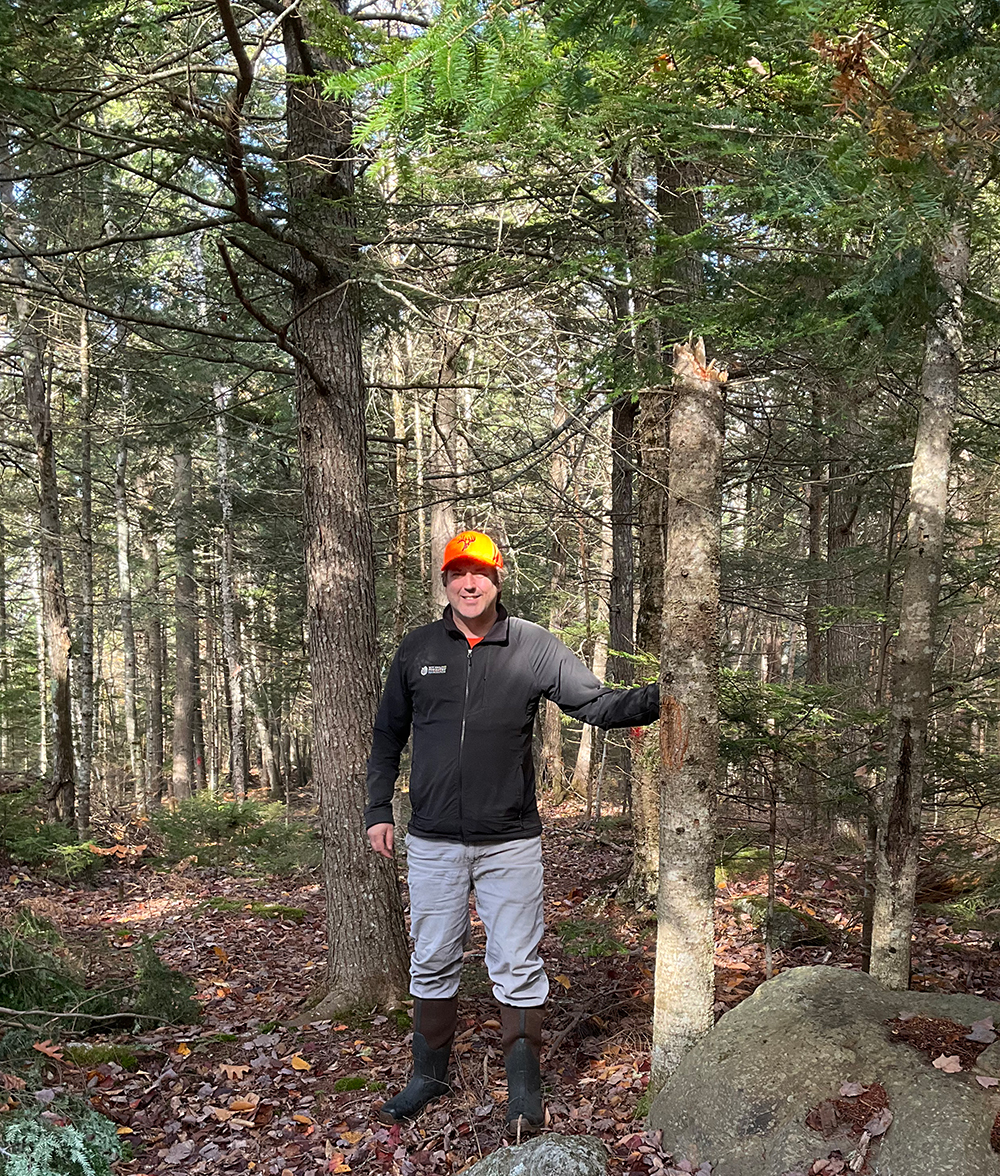
NEFF Conservation Easement Director Andrew Bentley on lands conserved through the Downeast Lakes Forestry Partnership. Photo by Kyle Burdick.
I awake in a cabin on the nearby Indian Township Passamaquoddy Reservation — the Partnership easements also border Passamaquoddy Trust Land — to mirror-calm water on Long Lake, silent except for loon calls. I next meet foresters Andrew Brown and Anne Favolise of Wagner Forest Management, who now represent the Typhoon LLC/Sunrise Tree Farm easement since the prior contact, Bob Cousins, left earlier this year to pursue a surveying career.
We pass several ongoing harvests and inspect new and past sites of concern, including what are now small encroachments and dumping areas that Wagner dutifully addresses as we discover them. UMaine’s imagery showed an unknown structure near or possibly over the property boundary on a remote hilltop, and we drive rough roads for miles to reach it, only to find no issue — the boundary data was slightly off and it’s an old collapsed camp outside the easement boundary. It’s in a fairly uncommon (for these parts) pure stand of hardwoods, mostly red oak and sugar maple, which feels more like southern Maine than the spruce-fir and hemlock forests that largely dominate far Downeast! We also encounter an incredible highlight: a sweeping view across Big Lake to Pine Island (Kuwesuwi Monihq), sacred land of the Passamaquoddy Tribe that they purchased in 2021 after 160 years of dispossession.
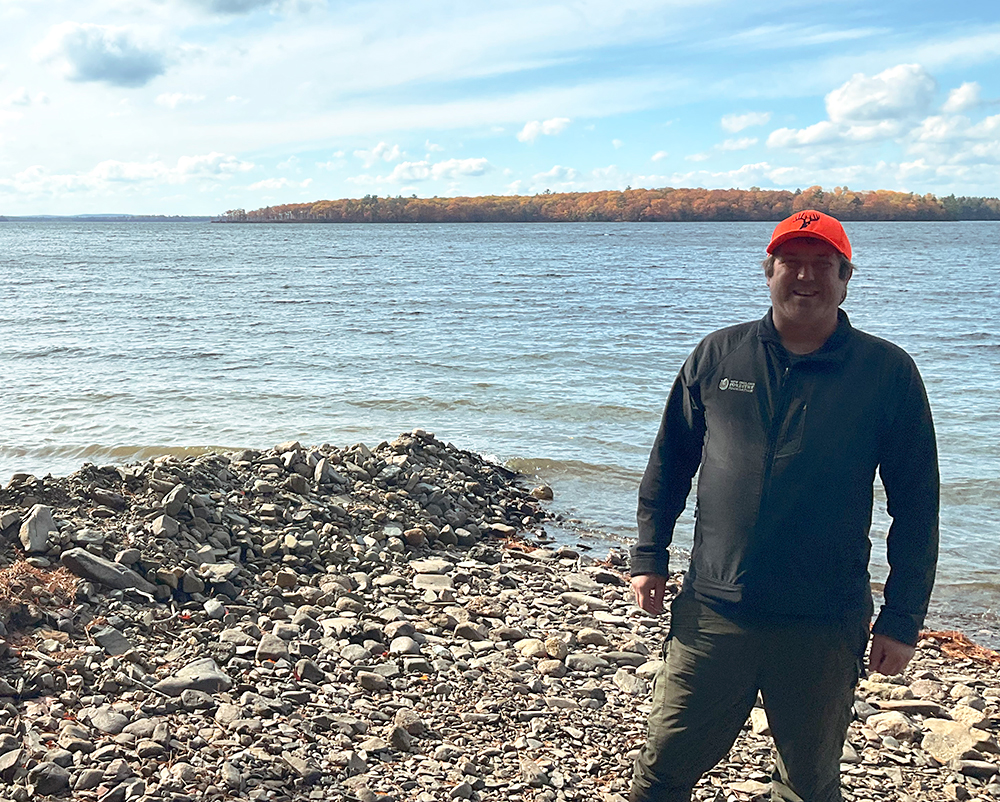
Andrew with Pine Island (Kuwesuwi Monihq) visible behind him.
I head to the farthest northern reaches of Sunrise Tree Farm to meet with Kyle Burdick of The Baskahegan Company, a family-owned timber management business that also owns significant working-forest acreage in Maine. We drive to remote Forest City at the county’s northern tip along the shores of Spednic Lake, part of the Saint Croix River that forms the Canadian border, passing one total car on the 35-mile roundtrip to the “city.” We see no logging, since Baskahegan is letting the easement forest grow for now and sold carbon credits on the land; they are paid to practice forestry that increases forest carbon levels over time.
We then drive south and east to Lambert Lake, known for its brook trout and landlocked salmon, to view property boundaries and newly completed survey work as we go. After parting ways with Kyle, I head back onto Typhoon’s nearby holdings in the townships of Vanceboro, Topsfield, and Kossuth to check some final points missed on Day 2, enjoying the solitude and flashes of brilliant late-season foliage before I depart.
I leave feeling confident these working forests are under careful, expert management that balances wood production with protection of natural resources, wildlife habitats, and public access that benefits the local community as the easements intended.
This year’s highlights were Ernest Carle and Kyle Burdick’s now familiar company, and meeting the new staff and land managers at DLLT and Wagner to continue building the collaborative relationships that are the foundation of successful easement stewardship.
This was my seventh annual trip to monitor the Downeast Lakes Forestry Partnership easements, which date back to 2004 and 2005 — we’re two fruitful decades down the path to perpetuity. In 20 more years, there’s no telling if I’ll still be on staff, but NEFF’s partnerships with DLLT, Wagner, and Baskahegan will continue. Permanent conservation is bigger than any of us who have the privilege to contribute to its success along the way.